Bangladesh knows how to manufacture at scale. The next challenge is proving it can deliver consistent quality, traceability and reliability at that scale.
The country’s ready-made garment (RMG) industry earned US$39.35 billion in FY2024–25, accounting for 81.49% of Bangladesh’s total export earnings. That’s a huge business built on international buyers trusting local manufacturers to deliver what they ordered, when they ordered it.
But the expectations are changing. Competitive pricing and production capacity are no longer enough. Buyers increasingly want consistent products, traceable materials, reliable suppliers and evidence that manufacturers can meet quality and compliance requirements.
And the pressure isn’t limited to garments. Bangladesh is looking to expand into higher-value textiles, technical fabrics, footwear, pharmaceuticals and other manufacturing industries. More complex production means more demanding specifications, more quality checks and less room for inconsistent processes.
The question is no longer whether Bangladeshi manufacturers need quality management. It’s whether their existing systems are ready for where the industry is heading.
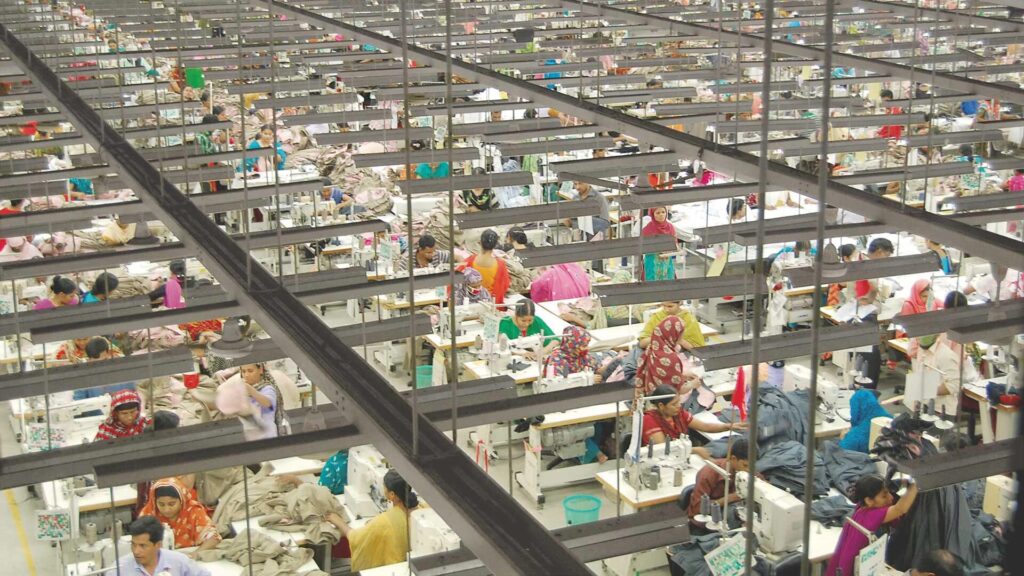
Bangladesh’s Manufacturing Industry Is Growing, and So Are Quality Expectations
Recent developments show why manufacturers need to take a closer look at how they manage quality.
| What’s happening | Why manufacturers should care |
| The move towards higher-value manufacturing | A BSS report on KOTRA’s observations highlighted opportunities in man-made fibres, functional textiles, automated sewing equipment and garment accessories. Higher-value products bring more specialised specifications and tighter process-control requirements. |
| Digital product traceability | BGMEA’s partnership with AWARE aims to develop Digital Product Passport readiness in Bangladesh’s garment industry. Manufacturers will increasingly need reliable information about materials, production processes and supply chains. |
| The updated ISO quality standard | The release of ISO 9001:2026 reinforces the importance of leadership, quality culture, accountability and risk-based thinking. Quality management is a business-wide responsibility, not simply an inspection function. |
These developments point in the same direction: manufacturers need to know what’s happening across their operations, demonstrate that their processes are under control and act when something goes wrong.
A factory that can produce a large order is valuable. A factory that can produce it consistently, document its processes and prove that its materials meet requirements is even more valuable.
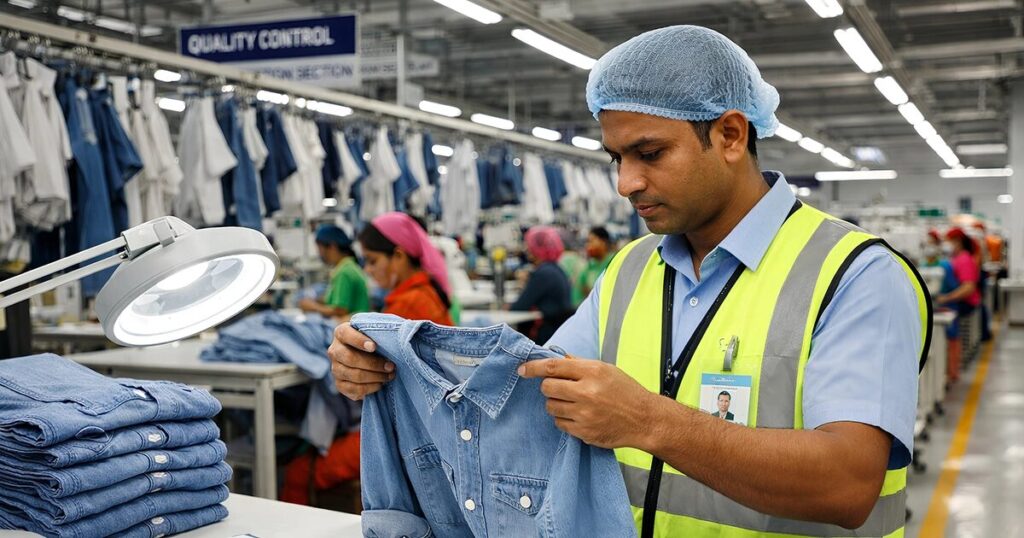
How Does Bangladesh Compare with the Global Quality Management Landscape?
Bangladesh has a large manufacturing base, but how many of its manufacturing businesses have a certified Quality Management System?
According to the Bangladesh Bureau of Statistics’ Economic Census 2024, the country had 1,119,401 manufacturing economic units. Of these, 462,936 were permanent establishments. The census also identifies 407,526 manufacturing establishments when economic households are excluded. These figures show the scale of the sector, although they include businesses of different sizes and ownership structures.
Meanwhile, the ISO Survey 2024 recorded 1,317 ISO 9001 certificates in Bangladesh across all industries. This is not a manufacturing-only figure, and certificates do not necessarily represent unique companies.
| Indicator | Number | What it represents |
| Manufacturing economic units in Bangladesh | 1,119,401 | All manufacturing units, including economic households |
| Permanent manufacturing establishments | 462,936 | Manufacturing establishments classified as permanent |
| Manufacturing establishments excluding economic households | 407,526 | Establishments outside the economic-household category |
| ISO 9001 certificates in Bangladesh | 1,317 | Certificates across all industries, not manufacturing alone |
Even without a precise manufacturing-only certification rate, the comparison highlights why quality management deserves attention. A structured QMS can help manufacturers:
- Reduce defects and rework: Identify recurring production problems and address their root causes.
- Maintain consistency: Ensure employees follow approved procedures and product specifications.
- Improve traceability: Keep organised records of materials, inspections, production activities and quality issues.
- Strengthen buyer confidence: Demonstrate that quality processes are controlled and documented.
- Make better decisions: Use inspection results, audit findings and performance records to identify areas for improvement.
Manufacturers without a structured QMS may face the opposite challenges: inconsistent procedures, repeated defects, missing records, reactive problem-solving, difficulty preparing for audits and weaker visibility over supplier and production issues.
A QMS does not guarantee that defects will disappear or that every buyer requirement will automatically be met. Its value lies in giving manufacturers a consistent way to prevent problems, identify failures and improve their processes.
What Happens When a Factory Has a QMS vs. When It Doesn’t?
Imagine two manufacturers producing the same product for the same buyer. Both have skilled employees, machinery and quality inspectors.
One manages quality through scattered spreadsheets, paper records and individual follow-ups. The other has documented procedures, controlled records, defined responsibilities and a process for investigating recurring defects.
Their production capacity might be similar. Their ability to manage problems is not.
| Situation | Without a structured QMS | With a structured QMS |
| Defect detection | Problems may only become visible during final inspection. | Checks can be built into different production stages. |
| Recurring defects | Workers fix the immediate problem, but its cause may remain. | Root causes are investigated and corrective actions followed up. |
| Documentation | Teams may use outdated or inconsistent records. | Approved documents and revisions are controlled. |
| Supplier quality | Material issues can be difficult to trace and investigate. | Supplier requirements and incoming quality checks can be managed systematically. |
| Audits | Teams scramble to collect documents and evidence. | Audit records and corrective actions are maintained as part of normal operations. |
| Management decisions | Decisions depend heavily on individual reports and experience. | Quality information supports more consistent decisions. |
This doesn’t mean every factory without ISO certification produces poor-quality goods. Plenty of manufacturers maintain strong quality practices without certification. The comparison is about having a reliable system rather than depending on people to remember every procedure and follow-up.
It also helps to understand the difference between quality assurance and quality control. One focuses on building reliable processes; the other checks whether products and outputs meet requirements. A good QMS brings both together.
The financial impact matters, too. A defect can mean more than a rejected product. It can lead to wasted materials, rework, overtime, delayed shipments, additional inspections and damaged buyer confidence.
The ASQ Cost of Quality framework groups these expenses into prevention, appraisal, internal failure and external failure costs. In simple terms, preventing a problem or finding it early is generally preferable to paying for it after it reaches the customer.
What a Garment Factory Can Teach Us About Quality Improvement
The best way to understand quality management is to take it off the conference-room slide and onto the production floor.
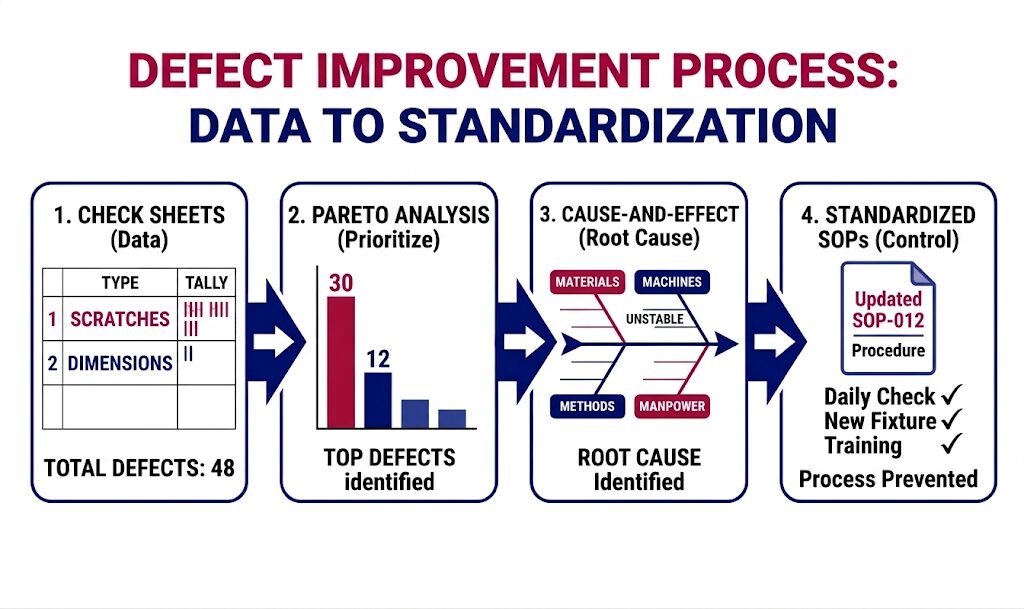
A research study on TQM implementation in Bangladesh’s RMG sector examined sewing defects in polo-shirt production. The researchers looked at problems such as open seams, uneven stitches, puckering, raw edges and attachment defects.
Instead of treating each defect as an isolated mistake, the study used quality management tools to identify patterns and investigate their causes.
| Step | What the factory did |
| Recorded defects | Check sheets helped identify which problems appeared most frequently. |
| Prioritised the biggest issues | Pareto analysis highlighted the defect types responsible for most of the quality problems. |
| Investigated root causes | Cause-and-effect analysis helped examine why the defects were occurring. |
| Standardised the work | Standard Operating Procedures (SOPs) were introduced to address the identified problems. |
The study also reported an improvement in its 5S assessment:
| Measurement | Score |
| Before improvement | 102 |
| After improvement | 163 |
The researchers also reported that the identified critical defect types accounted for the majority of sewing-line quality problems. This was a finding from the specific study, not a national industry benchmark.
The takeaway is practical: quality improvement doesn’t always begin with buying new machinery or hiring a larger inspection team. Sometimes, the biggest improvement comes from identifying the problems that keep repeating and standardising how the work is done.
That’s the difference between managing defects and managing the process that creates them.
What Should a Proper QMS Actually Cover?
A Quality Management System is not just a collection of ISO documents or a certificate displayed in the reception area. It is the framework that connects people, processes, responsibilities and records.
For a manufacturing organisation, the essentials include:
| QMS area | What it helps control |
| Document control | Approved SOPs, work instructions, forms and revisions. |
| Inspection and testing | Incoming materials, in-process checks and finished products. |
| Supplier quality | Supplier evaluation, material requirements and supplier-related issues. |
| Nonconformance management | Defects, deviations, complaints and other quality issues. |
| CAPA | Root-cause investigation, corrective action and prevention of recurrence. |
| Calibration and maintenance | Reliable measuring equipment and properly maintained machinery. |
| Training and competence | Whether employees understand the procedures and responsibilities relevant to their work. |
| Internal audits | Whether processes are being followed and where improvements are needed. |
| Management review | Whether the QMS is delivering the intended results and what needs attention. |
For example, nonconformance management helps organisations record, investigate and follow up on quality issues rather than treating each defect as an isolated incident.
Similarly, calibration management helps keep measuring equipment within its required calibration schedule, supporting reliable inspection and testing results.
The important thing is that these activities should work together. A defect identified during inspection should be recorded, investigated, assigned to someone and followed through until the corrective action has been evaluated. Otherwise, the organisation may simply keep fixing the same problem.
The ISO 9001:2026 Update: What Should Bangladeshi Manufacturers Do?
The release of ISO 9001:2026 is particularly relevant for organisations already certified to the previous edition.
The revision builds on the existing framework rather than requiring organisations to throw away their current QMS and start again. It includes clearer wording and a stronger emphasis on leadership, quality culture, accountability, and risks and opportunities.
What about the transition?
| Milestone | What it means |
| 31 March 2028 | New initial accredited certifications must use the revised standard. |
| 30 September 2029 | Organisations already certified to the previous edition must complete their transition. |
This is also an opportunity to review whether the current system is genuinely useful or has become an exercise in maintaining documents for auditors.
Why More Manufacturers Are Moving Towards Digital QMS Software
A paper-based system may seem manageable when a factory has a limited number of processes. But as operations expand, keeping documents, inspection records, audit findings, training records and corrective actions organised becomes increasingly difficult.
Consider a quality manager trying to answer a few ordinary questions:
- Has the latest approved SOP reached every relevant department?
- Who is responsible for closing an outstanding nonconformity?
- Has the corrective action actually worked?
- Which measuring equipment needs calibration?
- Are audit findings being addressed on time?
If answering these questions requires chasing several people and searching through different files, the system is creating work instead of helping manage it.
A digital QMS software solution for manufacturing can bring key quality activities into a more organised environment. QISS QMS supports processes such as document control, audits, nonconformance management, CAPA, calibration, maintenance and training.
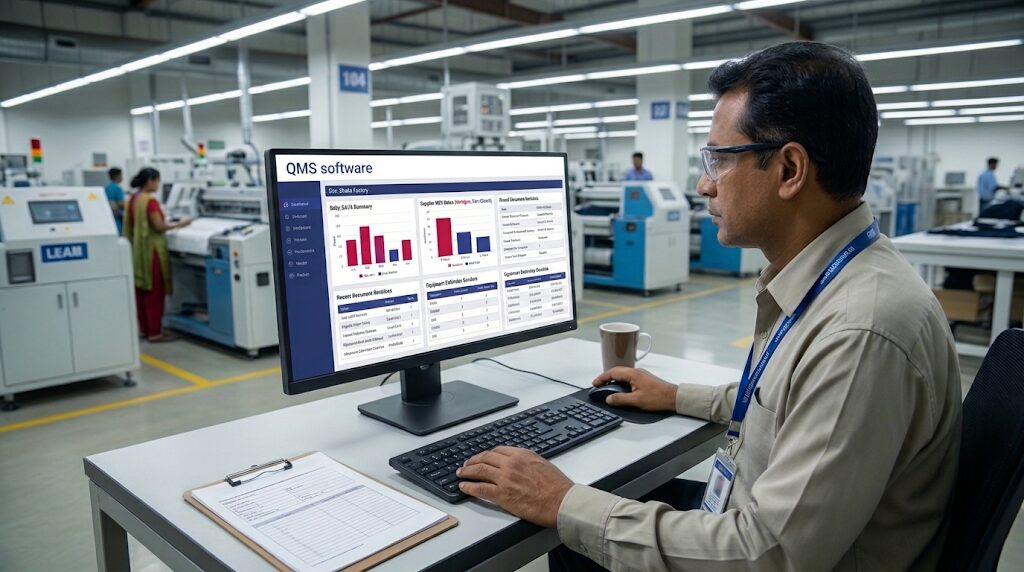
The point isn’t to digitise everything just for the sake of it. It’s to make quality information easier to manage, follow up and use.
The Quality Advantage Bangladesh Needs Next
Bangladesh has already established itself as a major manufacturing and export destination. The next stage is about moving further up the value chain, serving more demanding markets and producing increasingly specialised goods.
That will require more than competitive labour costs and production capacity. Manufacturers will need consistent processes, reliable suppliers, better traceability and quality systems that can keep pace with changing buyer and regulatory expectations. QMS software can help bring these activities together by giving teams a more structured way to manage quality records, monitor issues, track corrective actions and maintain oversight of ongoing processes.
For quality managers, directors, officers and advisors, this creates an opportunity to play a more strategic role. They are no longer just the people who identify defects. They help management understand operational risks, improve processes and protect customer confidence.
A factory should not have to wait for a failed inspection, a rejected shipment or an unhappy buyer to take quality seriously.
The manufacturers that build quality into everyday operations will be better positioned to compete on reliability, not just price.
See How QISS QMS Can Support Your Manufacturing Operations
Managing documents, audits, nonconformities, corrective actions, calibration and training across a growing manufacturing operation doesn’t have to mean juggling spreadsheets and endless email follow-ups.
Explore how QISS QMS can help bring your quality processes, records and follow-ups together.
Request a demo and see how it can support your manufacturing team’s quality management needs.
Related Articles
- How Quality Control Software Reduces Defects and Rework Costs in Manufacturing
- How to Manage Supplier Quality with a QMS Software?
- Document Control for Quality Assurance in the Manufacturing Industry
- Quality Assurance vs. Quality Control: Key Differences, Roles, and Best Practices
- ISO 9001 Requirements: A Complete Guide to the Key QMS Requirements