A supplier delivers defective materials. An operator uses an outdated procedure. A corrective action gets closed, but the same problem returns a month later.
These aren’t just quality problems. They’re signs that a Quality Management System (QMS) may not be working as intended.
ISO 9001 requirements help organizations control processes, meet customer requirements, and continually improve quality. But what does compliance actually involve, and what should organizations have in place?
This guide explains the key ISO 9001 requirements, practical examples, essential documentation, and how to prepare for an audit.
What Is ISO 9001?
ISO 9001 is an international standard specifying requirements for establishing, implementing, maintaining, and improving a QMS. It applies to organizations of all sizes and industries.
According to the International Organization for Standardization (ISO), more than one million certificates have been issued to organizations in 189 countries, making ISO 9001 the world’s most widely used quality management standard.
The current edition, ISO 9001:2026, was published on September 16, 2026. It maintains the established QMS framework while refining its clarity and emphasizing leadership, quality culture, and the management of risks and opportunities. Organizations certified to the previous edition should consult their certification body about transition arrangements.
What Are the Seven Main ISO 9001 Requirements?
ISO 9001 contains ten clauses. Clauses 1–3 cover the scope, references, and terminology; Clauses 4–10 establish the core QMS requirements.
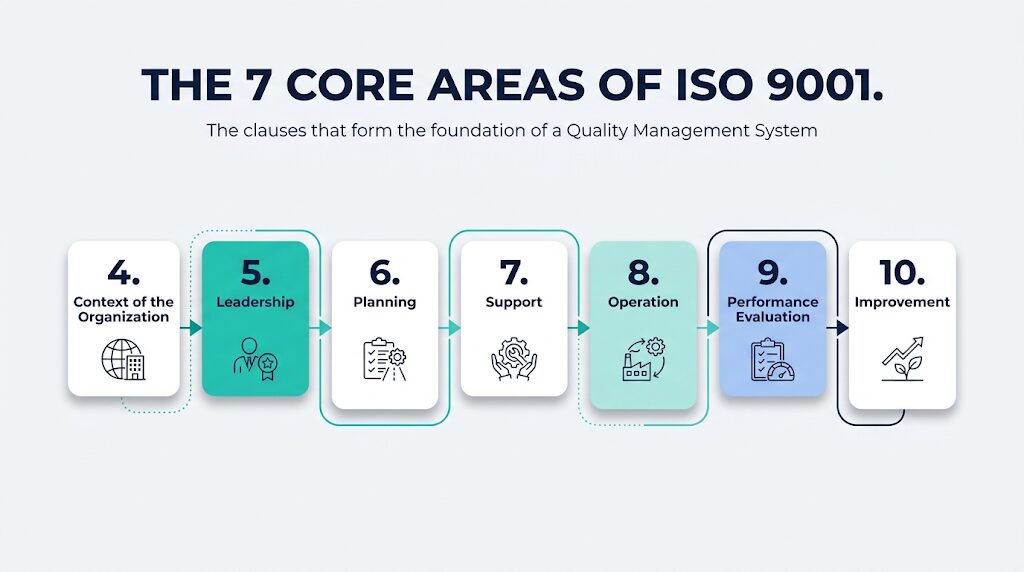
1. Context of the Organization (Clause 4)
Organizations must understand relevant internal and external issues, interested parties, the scope of their QMS, and the processes needed to achieve intended results.
In practice: A manufacturer considers customer specifications, supplier reliability, regulatory obligations, and production capacity when defining its quality controls.
2. Leadership (Clause 5)
Top management must demonstrate commitment to quality, establish a quality policy, assign responsibilities, and maintain customer focus.
In practice: Management ensures production targets don’t encourage employees to skip inspections or bypass established controls.
3. Planning (Clause 6)
Organizations must address relevant risks and opportunities, establish quality objectives, and plan changes that could affect the QMS.
In practice: A manufacturer experiencing repeated supplier defects strengthens supplier monitoring and establishes measurable objectives for reducing incoming defects.
4. Support (Clause 7)
Organizations must provide suitable resources, competent personnel, infrastructure, communication, and controlled documented information.
In practice: Employees receive appropriate training, measuring equipment is controlled where required, and current work instructions are available where needed.
Document control is particularly important: having a procedure isn’t enough if employees are following an obsolete version. A structured document control system for manufacturing can help organizations manage revisions and maintain access to current documents.
5. Operation (Clause 8)
Organizations must plan and control the processes used to provide products and services, including applicable customer requirements, supplier controls, production, inspection, and nonconforming outputs.
In practice: Incoming materials are checked against defined criteria, production follows approved instructions, and defective products are identified before unintended use or delivery.
6. Performance Evaluation (Clause 9)
Organizations must monitor and analyze relevant performance, evaluate customer satisfaction, conduct internal audits, and perform management reviews.
In practice: Quality teams track defect rates, customer complaints, and supplier performance, while internal audits assess whether processes work as intended.
7. Improvement (Clause 10)
Organizations must address nonconformities, take corrective action where necessary, and continually improve their QMS.
In practice: Instead of repeatedly repairing defective products, a manufacturer investigates why defects occur and verifies whether corrective action prevents recurrence.
What Documentation Is Required for ISO 9001?
ISO 9001 requires documented information in specified areas, but it doesn’t require every organization to maintain the same set of manuals and forms.
Depending on the organization’s processes, relevant documentation and records may include:
- QMS scope and quality policy
- Quality objectives and performance results
- Training and competency records
- Supplier evaluation and monitoring records
- Inspection and product-release records
- Calibration or verification records, where applicable
- Internal audit and management review records
- Nonconformity and corrective-action records
The key is to maintain the information necessary to demonstrate conformity and operate the QMS effectively. Documentation should support the work, not become work for its own sake.
How to Prepare for an ISO 9001 Audit
Audit readiness means being able to demonstrate that requirements are implemented, not simply having documents ready to show an auditor.
Use this practical checklist:
- Confirm the QMS scope and applicable requirements.
- Check that documents are approved, current, and accessible.
- Verify that employees understand their responsibilities.
- Review supplier evaluations and relevant inspection records.
- Check internal audit findings and corrective-action follow-up.
- Review quality objectives and performance trends.
- Confirm that management reviews take place and actions are followed up.
For a more structured review, use QIA’s ISO audit checklist tool to help assess your audit readiness and identify areas requiring further attention.
A useful audit also follows the process itself. For example, trace a purchase from supplier approval through incoming inspection and final disposition rather than checking each record in isolation.
When findings occur, organizations need to distinguish between correcting the immediate issue and addressing its cause. This is particularly important for common nonconformities in ISO audits, such as outdated documents, weak corrective actions, and processes that differ from documented procedures.
How Can QMS Software Support ISO 9001 Compliance?
Managing quality through separate spreadsheets, folders, and email threads can make it difficult to track responsibilities, retrieve records, and identify recurring problems.
A QMS software platform can help centralize quality activities and connect related records. For example, a supplier defect can be linked to an inspection record, nonconformance report, corrective action, and subsequent effectiveness review.
QISS QMS provides quality management capabilities that support workflows such as document control, audits, supplier quality, nonconformance management, and corrective action.
Software supports the system; it doesn’t replace competent employees, effective processes, management commitment, or conformity with the standard.
Build a QMS That Works Beyond the Audit
ISO 9001 requirements provide a framework for managing quality, from planning and operational control to performance evaluation and improvement.
The real test isn’t how many procedures an organization has. It’s whether those procedures guide actual work, problems are addressed effectively, and performance data leads to better decisions.
Want to make your quality processes easier to manage? Request a free QISS QMS demo to see how quality management software can help your team coordinate key QMS workflows.