Behind every recall is a quality problem, but the causes are rarely as simple as a single annual ranking suggests.
To understand what is driving these recalls, we analyzed FDA medical device recall data from 2023 through 2025, focusing on the FDA-determined causes associated with each recall [1].
Looking across three years reveals a more useful picture than any single year’s ranking. Some causes remain consistently prominent, while others rise, fall, or emerge unexpectedly.
So what does the data actually tell us about where medical device quality risks are concentrated and how those risks are changing?
Methodology & Data Boundaries
To evaluate where medical device quality risks are concentrated, we analyzed FDA recall data from 2023, 2024, and 2025, focusing exclusively on two fields: FDA Determined Root Cause and Quantity.
- Excluded Categories: Records classified as Under Investigation by firm, Unknown/Undetermined by firm, and Pending were excluded because they do not represent an established, determined cause.
- Retained Categories: Other was retained as an official FDA category. Zero-value entries were retained in the baseline dataset but excluded from annual rank logic.
- Analytical Groupings: In addition to evaluating individual FDA classifications, we created five functional quality groupings to observe macro-level shifts across interconnected Quality Management System (QMS) subsystems. These groupings were created specifically for this analysis and do not represent FDA classifications.
Analytical Groupings
Process-related
- Process control
- Process design
- Process change control
Materials and Components
- Nonconforming materials or components
- Component design or selection
- Component change control
- Contamination
- Material/component mix-ups
- Related material controls
Software-related
- Software design
- Software change control
- Software design changes
- Software manufacturing/deployment
- Software in the use environment
Labelling-related
- Labelling design
- Labelling change control
- Labelling errors
- Labelling mix-ups
- Misleading labelling
- Expiration-date issues
Packaging-related
- Package design or selection
- Packaging
- Packaging change control
- Packaging process control
Percentages are calculated against the total quantity of established, determined causes included in each year’s baseline.
The Biggest Causes of Medical Device Recalls
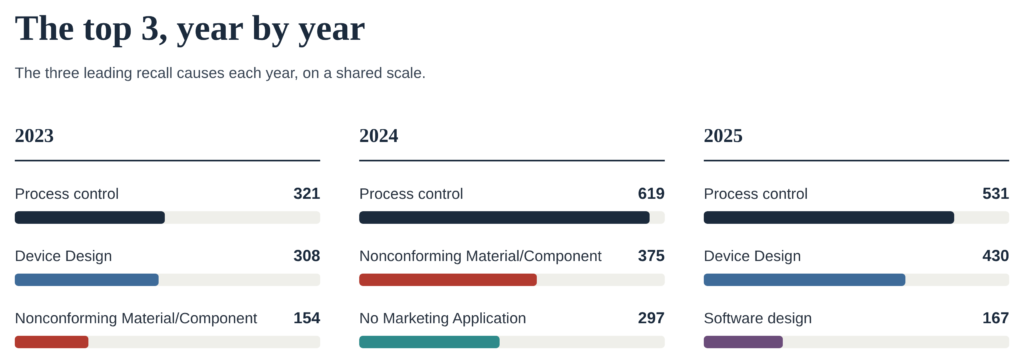
The year-by-year rankings show one particularly consistent finding: Process control remains the number-one FDA-determined cause throughout all three years.
Process Control Remains the Most Persistent Risk
Process Control ranked first in all three years, making it the most consistent quality concern in the data. This suggests that maintaining control over established manufacturing processes remains a major challenge for medical device manufacturers.
Device Design Remains a Major Risk
Device Design ranked second in 2023, fourth in 2024, and second again in 2025. Its continued presence among the top causes shows that quality risks can begin during the design stage, before manufacturing starts. Strong design controls, testing, and change management are therefore essential.
Nonconforming Materials/Components Fluctuate
Nonconforming Material/Component moved from third in 2023 to second in 2024, then fifth in 2025. The year-to-year variation highlights the importance of consistent supplier oversight, receiving inspection, and material controls rather than relying on one-time supplier approvals.
What the Top 10 Reveals
Looking beyond the three largest causes exposes several movements that are easy to miss in a Top 3 comparison.
Process Control Remained the Leading Cause
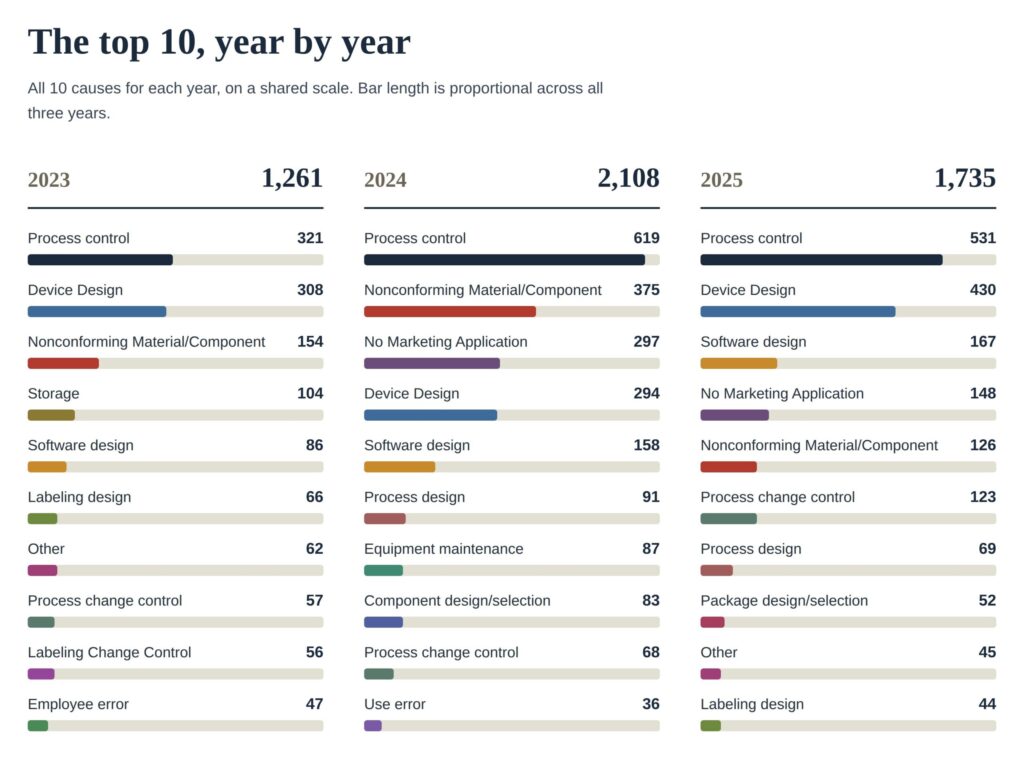
Process Control ranked #1 in all three years, with 321 occurrences in 2023, 619 in 2024, and 531 in 2025. Even after declining from its 2024 peak, it remained well above its 2023 level. The consistency of this finding shows that keeping established manufacturing processes under control remains one of the biggest quality challenges for medical device manufacturers.
Device Design Remained a Major Risk
Device Design ranked among the top four causes every year, reaching #2 with 430 occurrences in 2025. This highlights that quality problems can begin long before manufacturing. Strong design controls, verification, validation, risk management, and controlled design changes are therefore just as important as controlling the production process.
Software Design Nearly Doubled
Software Design rose from #5 in 2023 to #3 in 2025, increasing from 86 to 167 occurrences, a 94% increase. As software becomes a larger part of medical devices, manufacturers need quality processes that can keep requirements, testing, validation, changes, and documentation under control throughout the software lifecycle.
Process Change Control Gained Importance
Process Change Control increased from 57 occurrences in 2023 to 123 in 2025. Changes to established processes can introduce new risks if their impact is not properly assessed. Effective change control helps ensure that changes are reviewed, approved, validated where necessary, and reflected in related procedures, training, and records.
Nonconforming Materials Showed Year-to-Year Volatility
Nonconforming Material/Component moved from #3 in 2023 to #2 in 2024 and #5 in 2025. While its ranking fluctuated, it remained an important quality concern. This reinforces the need for consistent supplier oversight, incoming inspection, nonconformance management, and traceable material records.
The Bigger Picture: Quality Risks Are Connected
The data points to a broader lesson: quality problems rarely sit within one process. A design change can affect documents and training. A supplier issue can lead to a nonconformance and CAPA. A process change may require risk assessment, validation, and updated procedures.
Looking Beyond Individual FDA Causes
To identify broader patterns, we grouped related FDA causes into five quality areas: Process, Materials and Components, Software, Labeling, and Packaging.
Process-related Issues Became More Dominant
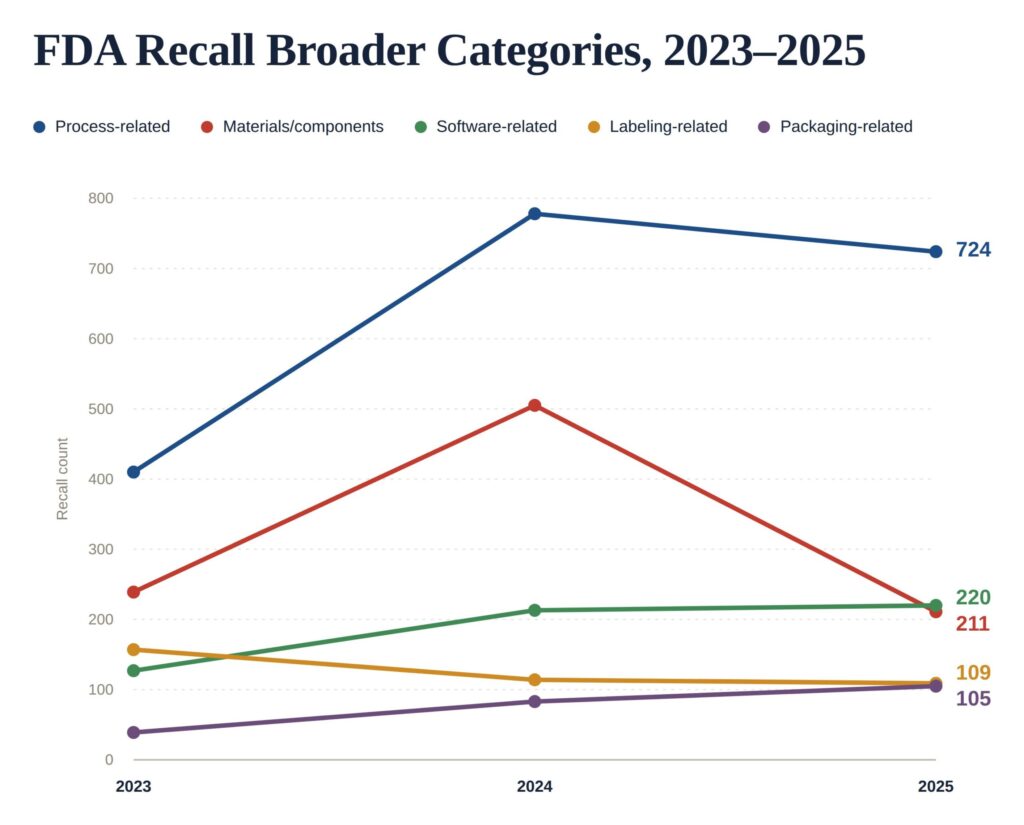
Process-related causes grew from 409 occurrences in 2023 to 778 in 2024, before falling slightly to 724 in 2025. Despite that decline, their share of total established causes continued to rise, from 26.3% in 2023 to 33.6% in 2025.
This makes process-related issues the largest quality area in the analysis. The trend shows that process control, process design, and process changes continue to account for a significant share of quality risk and need to be managed as connected activities.
Materials and Components Were Highly Volatile
Materials and component-related causes increased from 239 occurrences in 2023 to 506 in 2024, then dropped sharply to 211 in 2025. Their share of total causes followed the same pattern, moving from 15.4% to 20.2% and then 9.8%.
The large swings suggest that material and component risks can change significantly from year to year. This makes ongoing supplier monitoring, incoming inspection, material controls, and traceable records important for maintaining consistent oversight.
Software-related Risks Showed a Steady Rise
Software-related causes increased in every year, from 127 occurrences in 2023 to 213 in 2024 and 220 in 2025. Their share also rose steadily, from 8.2% to 10.2%.
Unlike materials and components, which fluctuated considerably, software-related causes followed a consistent upward trend. As medical devices become more dependent on software, quality teams need effective controls for software design, testing, validation, changes, and documentation throughout the product lifecycle.
Labeling-related Causes Declined Across the Period
Labeling-related causes fell from 156 occurrences in 2023 to 109 in 2025, while their share of total causes dropped from 10.0% to 5.1%.
The decline makes labeling one of the clearest changes among the five broader quality areas. It also highlights the importance of controls around labeling design, approvals, changes, and version management, particularly where errors, mix-ups, and expiration-date issues are involved.
Packaging-related Causes Showed an Emerging Trend
Packaging-related causes remained the smallest category by volume, but increased from 39 occurrences in 2023 to 84 in 2024 and 105 in 2025. That represents a 169% increase over the three-year period, while its share rose from 2.5% to 4.9%.
Although the numbers are still relatively small compared with process or materials-related causes, the consistent increase makes packaging worth monitoring. Looking only at the largest categories can cause smaller but steadily growing risks to receive less attention.
Change Control Emerges as a Cross-Cutting Risk
One pattern extends across several of the broader categories: change control.
Evaluating change-related classifications across all subsystems—including processes, components, software, packaging, labeling, and finished devices—uncovers a critical divergence in 2025 data.
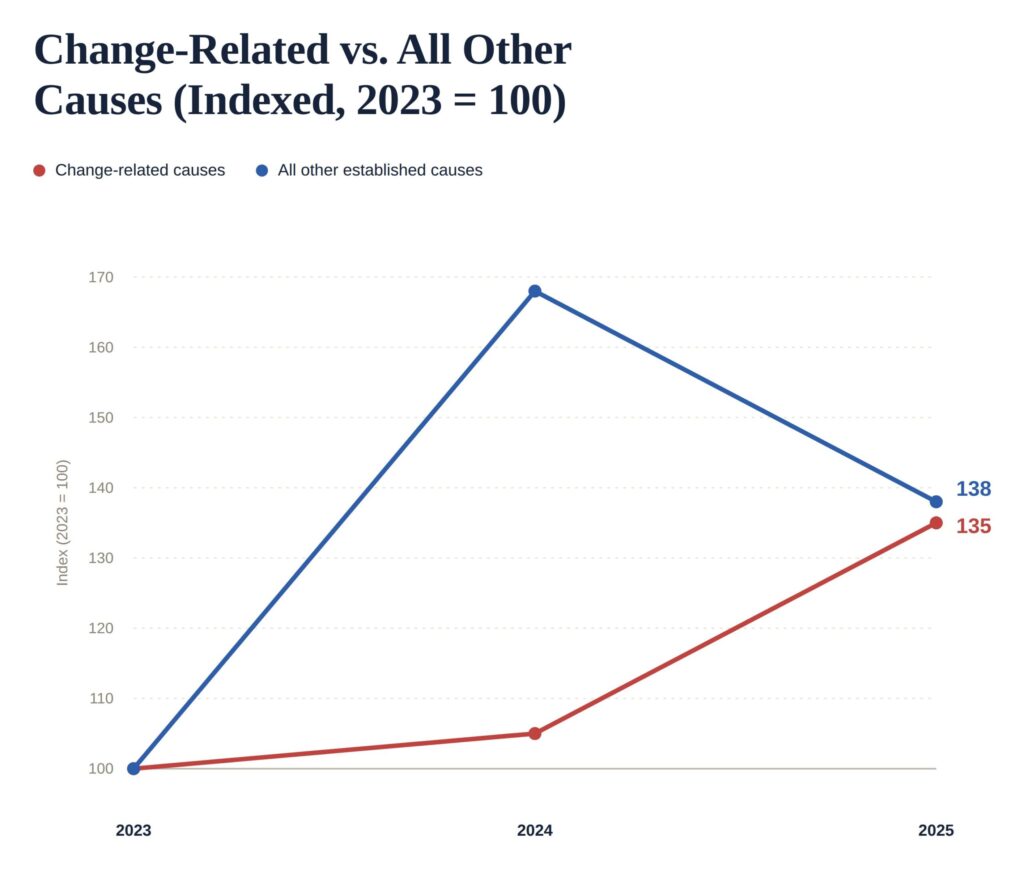
In 2025, while total established recall causes dropped by roughly 14% due to broad industry improvements, change-control failures surged by 28% (from 181 to 232 occurrences).
Unlike function-specific defects, change-control breakdowns represent a systemic failure across interconnected quality subsystems:
- A minor component substitution invalidates a validated specification.
- A software patch inadvertently alters intended use or regulatory filings without triggering a submission review.
- A manufacturing process modification is executed without updating employee training records or risk analysis (ISO 14971).
These systemic breakdowns are a frequent trigger for FDA Warning Letters, often paired with CAPA breakdowns. iRhythm Technologies was warned by the FDA in 2023 for exactly this: hardware, firmware, and algorithm changes made without a new regulatory submission or adequate validation [3].
This is a different kind of risk. A change can start in one area and create problems somewhere else, whether it involves a component, software, process, packaging, or labeling. The challenge is making sure its downstream impact is identified and addressed.
The issue is not simply getting a change approved. Teams also need to know what the change affects and ensure related documents, training, specifications, validation, and risk assessments are reviewed before closure. When these connections are managed across separate spreadsheets or systems, important follow-up steps can easily be missed.
The Business Cost of Unmanaged Quality
According to McKinsey & Company research, major medical device quality events—including recalls, regulatory enforcement actions, and associated litigation—cost the global industry $7 billion to $8.5 billion annually, representing approximately 2% of total sector sales.
- Equity Impact: Single major quality events routinely drive double-digit declines (10% to 13%) in enterprise share price.
- Operational Impact: Life sciences recall data shows that business interruption accounts for nearly 50% of total recall expenditure.
When a change-control failure forces a facility line down to perform retrospective investigations, lost manufacturing revenue far exceeds direct product retrieval and remediation costs.
Turning Recall Patterns Into Proactive Quality Action
The 2023–2025 FDA recall data shows that quality risks do not always remain within one department. Some causes persist, others fluctuate, and risks such as change control become clearer when related classifications are examined together.
The key takeaway is that the biggest risk is not always the highest-ranked cause. It can also be a rising trend, a persistent pattern, or a connection between seemingly separate problems.
QISS QMS connects document control, nonconformances, CAPA, root cause analysis, supplier management, risk, change management, and quality analytics in one platform, helping quality teams identify and address risks before they escalate.
Request a demo to see how QISS QMS can help your team stay ahead of emerging quality risks.
Reference
- Medical Device Recalls“, U.S. Food and Drug Administration (FDA), August 28, 2026.
- “Capturing the Value of Good Quality in Medical Devices“, McKinsey & Company.
- “iRhythm’s FDA Warning Letter Details Alleged Violations and Patient Deaths“, MassDevice, June 2023.
- “The Real Cost of a Product Recall and How to Prevent One“, Lumafield, 2026.