The ISO Survey 2024, compiled through IAF CertSearch — the International Accreditation Forum’s global database of accredited management system certifications — confirms a landmark year for internationally recognized management standards. Across quality, environmental, occupational health and safety, and medical device frameworks, global certification numbers have rebounded sharply from a reporting-anomaly dip in 2023 to reach multi-year highs, reflecting deepening organizational commitment to structured, audit-ready management systems.
This report presents a detailed analysis of four standards tracked across five years: ISO 9001:2015 (Quality Management), ISO 14001:2015 (Environmental Management), ISO 45001:2018 (Occupational Health & Safety), and ISO 13485:2016 (Medical Devices QMS).
Key Insights at a Glance
- ISO 45001 nearly tripled in 4 years: +184.9%
- ISO 14001 almost doubled: +94.2%
- ISO 9001 added 557,000+ new certificates since 2020: +60.8%
- ISO 13485 grew steadily every year through 2023: +21.7% overall
- The 2023 dip was a reporting anomaly — 2024 confirms the growth trend is intact
- Integrated Management Systems (IMS) combining all three major standards are rapidly becoming the global norm

Section 1: ISO 9001:2015 — Quality Management Systems
Five-Year Overview
| Year | Certificates | Year-on-Year Change |
| 2020 | 916,842 | — |
| 2021 | 1,077,884 | +17.6% |
| 2022 | 1,265,216 | +17.4% |
| 2023 | 837,978 | −33.7% |
| 2024 | 1,474,118 | +75.9% |
ISO 9001:2015 remains the world’s most widely adopted management system standard. After two consecutive years of strong growth in 2021 and 2022, certificate numbers fell sharply in 2023 — a dip attributed primarily to incomplete reporting by Certification Bodies in key markets, including China’s withholding of full data. The 2024 rebound to 1,474,118 certificates — the highest figure in the standard’s five-year history — reflects both genuine adoption growth and significantly improved data completeness through IAF CertSearch.
Top 10 Countries by Certificate Count (2024)
| Rank | Country | Certificates | Sites |
| 1 | China | 651,851 | 994,266 |
| 2 | Italy | 101,426 | 157,890 |
| 3 | India | 95,007 | 116,866 |
| 4 | Korea, Rep. | 51,647 | 59,511 |
| 5 | Germany | 45,983 | 104,193 |
| 6 | Spain | 41,616 | 84,805 |
| 7 | Japan | 41,525 | 67,347 |
| 8 | United Kingdom | 32,988 | 55,589 |
| 9 | United States | 28,783 | 47,463 |
| 10 | Brazil | 18,536 | 29,336 |
China dominates with 651,851 certificates — nearly 44% of the global total. Italy and India follow at a significant distance with 101,426 and 95,007 respectively, confirming that ISO 9001 adoption is a truly global phenomenon with particularly deep penetration across Asia and Europe.
Key Sector Highlights
The largest certified sectors (where sector data is reported) include:
- Basic metal & fabricated metal products: 26,896 certified sites
- Wholesale & retail trade / motor vehicles: 21,542 sites
- Electrical and optical equipment: 17,775 sites
- Machinery and equipment: 13,652 sites
- Construction: 12,704 sites
- Engineering services: 11,797 sites
- Health and social work: 7,896 sites
Section 2: ISO 14001:2015 — Environmental Management Systems
Five-Year Overview
| Year | Certificates | Year-on-Year Change |
| 2020 | 348,218 | — |
| 2021 | 420,433 | +20.7% |
| 2022 | 529,853 | +26.0% |
| 2023 | 300,410 | −43.3% |
| 2024 | 676,232 | +125.1% |
ISO 14001 recorded the most dramatic single-year rebound of any standard tracked in the 2024 survey, nearly doubling from 300,410 certificates in 2023 to 676,232 — a 125% increase. Again, the 2023 dip was attributable largely to reporting gaps rather than a genuine decline in adoption. The 2024 figure is also well above the previous peak of 529,853 in 2022, marking a genuine net expansion in environmental management system adoption globally.
This surge mirrors a broader organizational shift: sustainability is no longer treated as a compliance checkbox but as a competitive and supply-chain prerequisite. Organizations in manufacturing, construction, and heavy industry increasingly pursue ISO 14001 alongside ISO 9001 as part of an Integrated Management System (IMS) approach.
Top 10 Countries by Certificate Count (2024)
| Rank | Country | Certificates | Sites |
| 1 | China | 381,019 | 638,982 |
| 2 | Korea, Rep. | 28,137 | 33,016 |
| 3 | Italy | 28,116 | 52,904 |
| 4 | Japan | 22,932 | 40,186 |
| 5 | Spain | 20,836 | 44,642 |
| 6 | India | 17,609 | 27,273 |
| 7 | United Kingdom | 16,140 | 30,523 |
| 8 | Germany | 10,473 | 26,321 |
| 9 | Australia | 8,575 | 16,246 |
| 10 | Romania | 7,103 | 9,508 |
China’s contribution of 381,019 certificates — nearly 56% of the global total — underscores the enormous scale of its environmental compliance infrastructure. East Asian nations (Korea, Japan) are particularly active, reflecting both regulatory pressure and export-market requirements tied to green supply chains.
Key Sector Highlights
- Construction: 7,183 certified sites
- Wholesale & retail trade / motor vehicles: 7,805 sites
- Electrical and optical equipment: 7,624 sites
- Basic metal & fabricated metal products: 7,999 sites
- Engineering services: 4,483 sites
- Rubber and plastic products: 4,914 sites
- Transport, storage, and communication: 5,251 sites
Section 3: ISO 45001:2018 — Occupational Health & Safety Management Systems
Five-Year Overview
| Year | Certificates | Year-on-Year Change |
| 2020 | 190,429 | — |
| 2021 | 294,420 | +54.6% |
| 2022 | 397,339 | +34.9% |
| 2023 | 185,166 | −53.4% |
| 2024 | 542,527 | +193.0% |
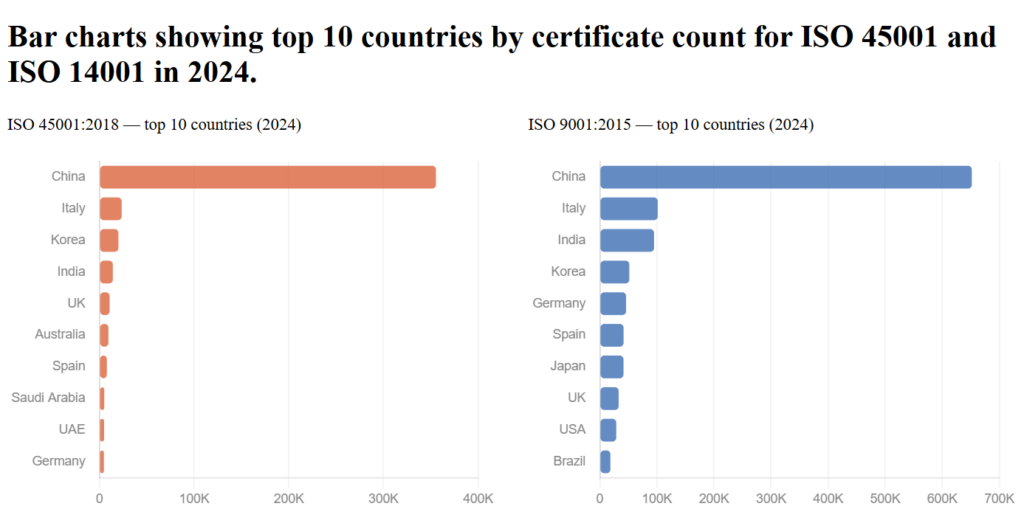
ISO 45001:2018 tells the most compelling growth story of this survey cycle. Since the standard was introduced in 2018 to replace OHSAS 18001, adoption has grown at an extraordinary pace. Even accounting for reporting disruptions in 2023, the trajectory from 190,429 certificates in 2020 to 542,527 in 2024 represents a near-tripling of globally certified organizations in just four years. The 2024 figure surpasses the previous high of 397,339 in 2022 by over 36%, confirming that the transition from OHSAS 18001 to ISO 45001 is now broadly complete worldwide — and that new organizations are continuing to certify at scale.
Top 10 Countries by Certificate Count (2024)
| Rank | Country | Certificates | Sites |
| 1 | China | 355,480 | 597,816 |
| 2 | Italy | 23,502 | 49,306 |
| 3 | Korea, Rep. | 20,024 | 24,225 |
| 4 | India | 14,171 | 22,108 |
| 5 | United Kingdom | 10,757 | 20,329 |
| 6 | Australia | 9,467 | 19,253 |
| 7 | Spain | 7,753 | 19,568 |
| 8 | Saudi Arabia | 5,148 | 6,010 |
| 9 | UAE | 4,882 | 7,483 |
| 10 | Germany | 4,732 | 11,907 |
The United States holds a relatively modest position (2,427 certificates, ranked 20th) compared to its economic weight, suggesting significant untapped headroom for ISO 45001 adoption in North America. The Middle East is notably active, with Saudi Arabia and the UAE both appearing in the global top 10 — reflecting stringent occupational safety requirements in their energy, construction, and infrastructure sectors.
Notable Regional Presence
Beyond the top 10, Pakistan (1,038 certificates), Indonesia (3,448), Romania (3,639), and Colombia (2,750) represent important mid-tier certification markets where industrial growth is driving demand for internationally recognized safety frameworks.
Key Sector Highlights
- Construction: 5,290 certified sites
- Wholesale & retail / motor vehicles: 4,743 sites
- Basic metal & fabricated metal products: 4,005 sites
- Other services: 3,929 sites
- Other social services: 3,554 sites
- Transport, storage, and communication: 3,767 sites
- Financial intermediation & real estate: 1,132 sites
Section 4: ISO 13485:2016 — Medical Devices Quality Management
Five-Year Overview
| Year | Certificates | Year-on-Year Change |
| 2020 | 25,656 | — |
| 2021 | 27,229 | +6.1% |
| 2022 | 29,741 | +9.2% |
| 2023 | 32,963 | +10.8% |
| 2024 | 31,215 | −5.3% |
ISO 13485:2016 stands apart from the other three standards in this survey in one important way: it was the only standard to show continuous, uninterrupted growth from 2020 through 2023 — a sign that its specialist, regulation-driven market is less susceptible to the reporting fluctuations that affected the broader management standards. The slight decline to 31,215 in 2024 (from a peak of 32,963 in 2023) is marginal and may reflect reporting participation differences rather than a genuine market contraction.
ISO 13485 governs quality management systems specifically for medical device design, manufacture, and distribution. Its steady growth trajectory reflects tightening regulatory requirements globally — including the EU Medical Device Regulation (MDR 2017/745), FDA quality system expectations, and increased scrutiny on medical supply chains following the COVID-19 pandemic.
While its absolute certificate count is far smaller than ISO 9001 or ISO 14001, ISO 13485 carries a higher compliance burden per certificate — making each certification a significant organizational investment and a meaningful signal of readiness to operate in regulated healthcare markets worldwide.
Section 5: The 2023 Dip — Context and Explanation
A striking feature of the five-year dataset is the sharp drop across ISO 9001, ISO 14001, and ISO 45001 in 2023, followed by record or near-record highs in 2024. This pattern is not primarily a reflection of real-world certification trends. It is largely a data collection artifact.
Prior to 2024, Certification Bodies submitted data to the ISO Survey on a voluntary basis. Participation fluctuated year to year. In 2023, China — the world’s single largest contributor to global certification totals — did not fully submit data across several key standards. This absence alone was sufficient to depress global totals significantly. Germany’s DAkkS certification body non-participation also affected 2024 figures to a lesser degree.
From the 2024 survey cycle onward, data is compiled directly from IAF CertSearch, which aggregates anonymized, accredited data from 76 of 77 accreditation bodies globally and their 2,400+ affiliated Certification Bodies. This shift to a systematic, database-driven methodology is expected to produce more consistent and comparable results in future survey cycles — making the 2024 data a more reliable baseline than any prior year.
Section 6: What the Data Means for Organizations
The 2024 ISO Survey sends a clear message to any organization still treating management system certification as optional or aspirational: the global competitive and regulatory landscape has moved on. The convergence of four simultaneous trends is accelerating adoption across all standards:
- Supply chain pressure: Customers and procurement teams — particularly in Europe, East Asia, and the Middle East — increasingly require ISO certification as a baseline supplier qualification. ISO 9001 and ISO 14001 appear as standard requirements in tenders across manufacturing, construction, and services.
- Regulatory alignment: ISO 45001 is increasingly referenced in national occupational health legislation across APAC, the Middle East, and Latin America. ISO 13485 is embedded in medical device market-access requirements globally.
- Sustainability commitments: The surge in ISO 14001 adoption is directly linked to corporate ESG commitments, scope 3 emissions reporting pressures, and green procurement policies proliferating across global supply chains.
- Integrated Management Systems (IMS): A growing proportion of organizations are simultaneously holding ISO 9001, ISO 14001, and ISO 45001 certifications — building unified management frameworks that reduce audit overhead and improve cross-functional accountability.
For organizations that currently manage these standards through manual processes, spreadsheets, or disconnected tools, the scale of the data above carries an implicit challenge: at 1.4 million ISO 9001 certificates and growing, the differentiator is no longer having the certification — it is how efficiently, accurately, and continuously you can maintain, audit, and improve the underlying system.
Is Your Management System Ready to Scale With Global Standards?
With over 1.4 million ISO 9001 certificates issued worldwide — and ISO 14001 and ISO 45001 adoption accelerating fast — the organizations pulling ahead aren’t just certified. They’re managing their systems smarter.
QISS QMS helps quality and compliance teams maintain audit-ready management systems, close nonconformances faster, and stay aligned with ISO 9001, ISO 14001, and ISO 45001 — without the spreadsheet chaos.
Your certification is the starting line. QISS QMS is how you stay ahead.
Book a free demo ‘or’ explore QISS QMS
Reference
ISO Survey 2024, International Accreditation Forum (IAF) / IAF CertSearch. Data reflects valid certificates as of 31 December 2024. Sector data reflects reported figures only; a significant proportion of certificates are filed under “sector not known” in all standards.