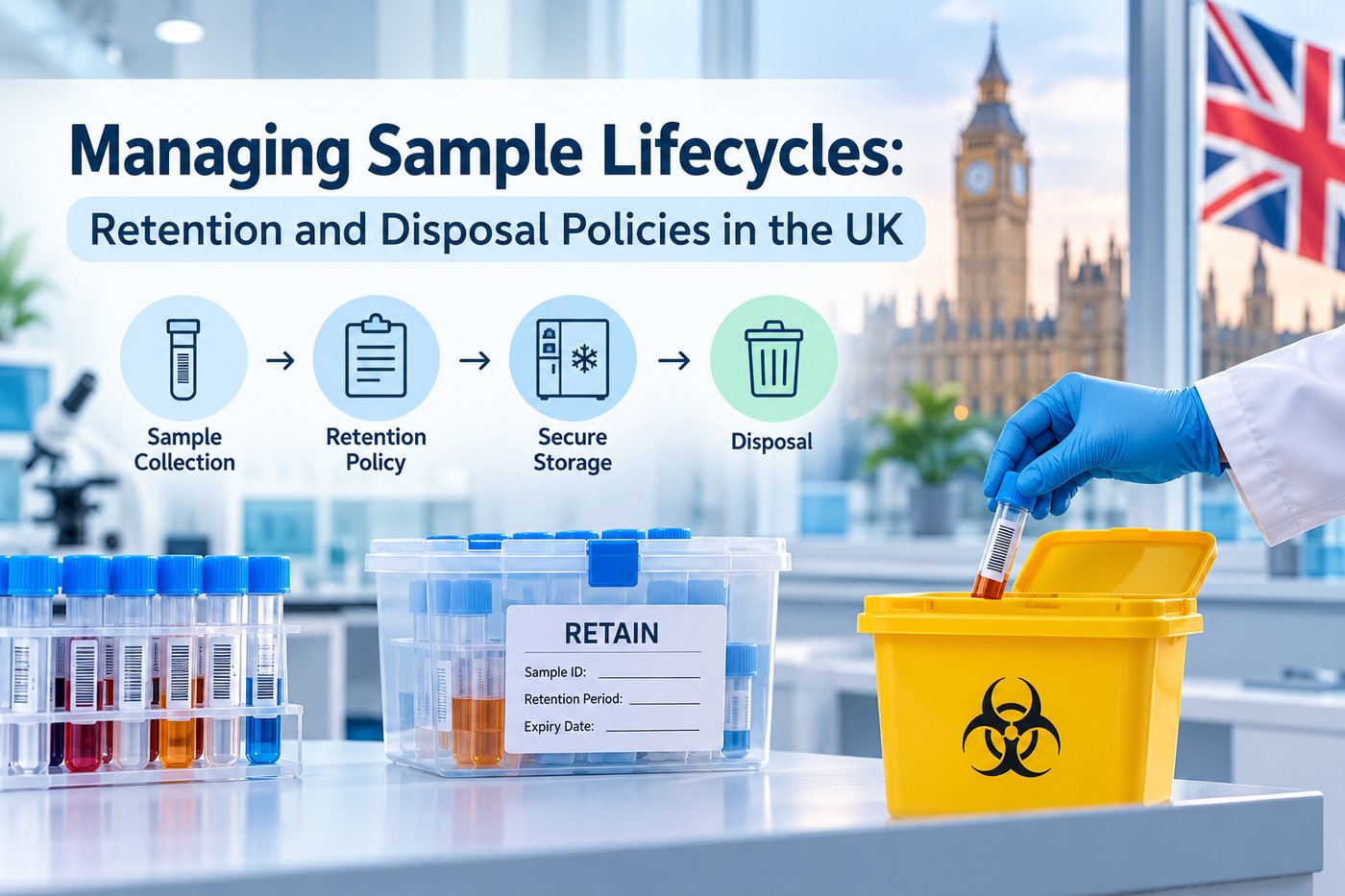
A sample sitting in a freezer may look like a storage problem. In practice, it can be a records-management problem too.
How long does it need to stay there? Who decides when it can be disposed of? What happens if additional testing or an investigation comes up just before the retention period ends? And can the laboratory show what happened to it afterwards?
For UK laboratories, sample retention is not simply about choosing a number of days and putting it on a spreadsheet. It is about having a clear, defensible process for retention, review and disposal.
There is no single retention period that applies to every laboratory sample. NHS England’s pathology retention guidance distinguishes between information relating to a specimen and the physical clinical material itself, with retention of clinical material potentially depending on ongoing clinical need.
That makes a well-defined retention policy essential.
What Should a Sample Retention Policy Cover?
“Keep it until it is no longer needed” sounds straightforward. It is not much use as a working policy.
A laboratory needs to know what “no longer needed” actually means, who makes that decision and what happens when the normal retention period is reached.
A practical retention policy should define:
- Which sample types are covered
- Why each type needs to be retained
- The normal retention period or review point
- Storage requirements
- Who is responsible for reviewing retention
- When retention can be extended
- What happens when the retention period ends
- How disposal is recorded
The wider UK approach to records management follows the same principle. Information should be managed throughout its lifecycle, with clear ownership, routine review and controlled disposal rather than indefinite accumulation. HMRC’s records management and retention and disposal policy also emphasises designated ownership, retention schedules, traceability and secure disposal.
For laboratories, the same thinking can be applied to samples and the information associated with them.
How Should Laboratories Set Retention Periods?
There is a temptation to look for one standard UK retention period and apply it across the board. That is unlikely to work.
Different samples have different purposes, stability, testing requirements and clinical significance. The appropriate retention period should therefore be based on the type of sample and the reason it needs to remain available.
Start With the Sample Type
A routine specimen may have very different retention requirements from a specialist or archived sample.
Rather than applying one timeframe to every specimen, laboratories should establish retention periods according to:
- Sample type
- Intended use
- Possibility of repeat testing
- Clinical need
- Applicable professional or regulatory requirements
- Storage conditions and sample stability
The NHS pathology retention guidance demonstrates why a single blanket period is inappropriate. Different categories of pathology material can have different retention arrangements.
The aim is not to retain every sample for as long as possible. It is to retain the right samples for the right reasons.
Consider What Could Happen After Testing
Before a sample reaches the end of its normal retention period, ask whether there is still a reason to keep it.
For example:
- Could additional testing be required?
- Is an investigation still open?
- Is there an unresolved complaint?
- Is an audit underway?
- Is there an ongoing clinical need?
- Is there a legal or regulatory reason to retain it?
If the answer is yes, the sample may need to remain in storage beyond its normal review point.
The reason should be recorded rather than relying on someone remembering why it was kept.
Build a Retention Schedule That Staff Can Actually Use
A retention policy explains the rules. A retention schedule helps staff apply them.
For each sample category, the schedule should make it clear:
Sample type: What material does the rule apply to?
Retention period: How long is it normally kept?
Review date: When should someone reassess whether it is still needed?
Storage requirements: Where and under what conditions should it be stored?
Responsible role: Who reviews or approves continued retention?
Disposal action: What happens when the retention requirement has been met?
Exceptions: What circumstances prevent normal disposal?
This is where retention management becomes practical rather than theoretical.
HMRC’s approach similarly requires records to be reviewed against retention and disposal schedules, with business areas responsible for maintaining their own schedules and keeping an audit trail of review and disposal decisions.
For a laboratory, that means a sample should not simply disappear into storage with no clear review point.
Retention Should Trigger a Review
Reaching a retention date should not automatically mean “dispose”.
It should mean review.
Before disposal, the laboratory should be able to establish whether:
- The normal retention period has expired
- Additional testing is required
- An investigation or complaint remains open
- A legal or regulatory requirement applies
- There is an ongoing clinical need
- The sample can be safely and appropriately disposed of
- Retention needs to be extended
This creates a useful distinction between a retention period and a disposal decision.
The former provides a normal timeframe. The latter confirms whether the sample is actually ready to leave the laboratory.
What Happens When the Normal Retention Period Is Extended?
Exceptions are inevitable. The problem is when they are handled informally.
A sample may need to be retained beyond its normal period because of:
- An ongoing investigation
- A legal enquiry
- An audit
- A complaint
- Further testing
- A clinical requirement
- Another documented reason
The extension should have a reason and, ideally, another review point.
Otherwise, a temporary exception can easily become permanent storage.
For example, if a sample is retained because an investigation is ongoing, the laboratory should be able to identify that status rather than leaving staff to work it out from old emails or notes.
This is also why ownership matters. Someone should be responsible for reviewing the exception and deciding when the sample can move towards disposal.
Don’t Forget the Information Around the Sample
The physical sample is only part of the story.
A laboratory may also hold:
- Sample identifiers
- Collection details
- Receipt information
- Test history
- Results
- Storage location
- Associated documentation
- Retention status
- Disposal records
These records may not necessarily have the same retention period as the physical sample. Clear documentation and record-keeping for lab samples helps maintain the link between a specimen and its associated information, even after the physical material has been disposed of.
This distinction matters because disposing of a specimen does not automatically mean that every piece of information associated with it should also be deleted. Laboratories need to understand what information must remain available, where it is stored and how it relates to the physical sample.
Disposal Needs Its Own Process
Once a sample reaches the end of its retention period and there is no reason to extend it, disposal should be a controlled step in the lifecycle.
Review Before Disposal
Confirm that there is no outstanding reason to retain the sample.
This includes checking for pending testing, investigations, complaints, audits, legal requirements or documented holds.
Use the Appropriate Disposal Route
The disposal method will depend on the type of material and the laboratory’s procedures.
Where healthcare waste is involved, the relevant waste stream needs to be identified and classified before disposal. The GOV.UK healthcare waste guidance provides guidance on classifying healthcare and related waste.
Record What Happened
A disposal record provides evidence that the sample was dealt with according to the laboratory’s process.
Depending on the laboratory, this might include:
- Sample or batch identifier
- Disposal date
- Disposal method
- Person or role responsible
- Reason for disposal
- Relevant authorisation or exception
This can be particularly useful during an audit or investigation. If someone asks, “What happened to this sample?”, the laboratory should not have to reconstruct the answer from a collection of spreadsheets and emails.
Where Manual Tracking Starts to Break Down
Writing a retention policy is relatively easy.
Applying it consistently across thousands of samples is harder.
Manual tracking can create problems when retention information is spread across spreadsheets, storage logs, emails and individual records.
Common issues include:
- Retention dates being maintained manually
- Difficulty identifying samples approaching review
- Inconsistent recording of retention extensions
- Unclear ownership of disposal decisions
- Limited visibility of sample locations
- Missing disposal records
- Duplicate information across different systems
- Time spent checking and updating records
The problem is not necessarily the policy itself.
It is the gap between having a retention rule and being able to apply that rule consistently across the laboratory.
A consistent sample tracking process helps laboratories maintain visibility of sample locations, status and movement, reducing the risk of information being lost between different records.
How Sample Management Software Can Help
A sample management software system can bring sample information, tracking and related workflows into one place.
Instead of relying on disconnected spreadsheets and manual records, laboratory teams can have greater visibility of samples throughout their lifecycle.
Useful capabilities can include:
- Sample tracking
- Inventory management
- Digital documentation
- Real-time access to sample information
- Workflow automation
- Reporting
The software does not decide how long a laboratory should retain a particular sample. That decision comes from the laboratory’s policies, applicable requirements and professional judgement.
Its role is to make those rules easier to apply, monitor and document consistently.
Managing the Full Sample Lifecycle
A useful way to think about sample management is:
Receive → Identify → Test → Store → Review → Retain or Dispose → Record
The important part is what happens between those steps.
A sample should remain identifiable while it is stored. Its status should be clear. Exceptions should be visible. Review points should not depend on someone remembering to check a spreadsheet. And once the sample is disposed of, there should be a record of what happened.
When these stages are connected, laboratories can improve sample management efficiency and accuracy while maintaining better oversight of samples from receipt through to final disposal.
That is what turns sample retention from a storage task into a controlled laboratory process.
Manage Sample Information Throughout Its Lifecycle
Effective sample management is not simply about knowing where a sample is.
It is about knowing why it is being retained, when it should be reviewed, who is responsible for the decision, and what happened when its lifecycle ended.
QISS LAB helps laboratories manage sample information, tracking, inventory, documentation and related workflows in one system.
With capabilities for laboratory inventory management and sample tracking, QISS LAB can help reduce reliance on disconnected records and give laboratory teams greater visibility across their sample inventory.
Request a QISS LAB demo to see how it can support your laboratory’s sample management processes.
Related Articles
- How to Track Samples Efficiently in Lab?
- Documentation and Record-Keeping Best Practices for Lab Samples
- How Does Sample Management Systems Improve Lab Efficiency and Accuracy?
- Managing Lab Inventory: How to Do It Right and Why It Matters?
- From Spreadsheets to Smart Systems: The Evolution of Lab Sample Tracking