Approximately 70% of medical decisions rely on laboratory test results, yet nearly 80% of clinical laboratories report complaints about slow turnaround times (TAT), according to Roche Diagnostics’ analysis of laboratory turnaround time. For laboratories, delays can affect more than operational efficiency—they can frustrate clinicians and clients, disrupt workflows, and undermine confidence in the service.
But not every TAT problem begins with the testing process itself. A sample that is difficult to identify, locate, retrieve, or route through the laboratory can create delays long before analysis begins. Effective laboratory sample management helps prevent these bottlenecks by keeping samples organized, traceable, and visible throughout their lifecycle.
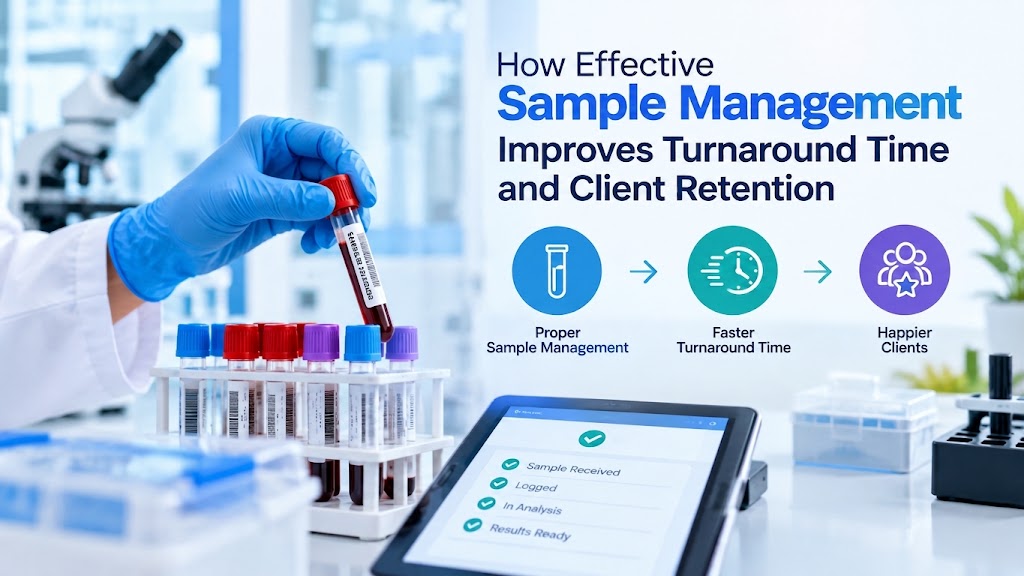
By improving sample tracking, reducing errors and rework, and giving staff faster access to the information they need, laboratories can shorten turnaround times while delivering a more reliable client experience. This article shows you how effective sample management can improve laboratory efficiency, reduce TAT, and ultimately support stronger client retention.
What Is Laboratory Sample Management?
Laboratory sample management is the systematic process of receiving, identifying, tracking, processing, storing, retrieving, and disposing of samples while maintaining their integrity and traceability throughout the sample lifecycle.
An effective sample management process typically covers:
- Sample collection and receipt: Recording when, where, and from whom a sample was received.
- Identification and labeling: Assigning unique identifiers, often using barcodes, to prevent misidentification.
- Sample registration: Capturing relevant sample information, test requirements, and associated records.
- Tracking and traceability: Monitoring each sample’s status, location, movement, and handling history.
- Processing and storage: Ensuring samples are handled and stored under appropriate conditions.
- Retrieval: Allowing staff to quickly locate samples when additional testing, review, or retesting is required.
- Quality and documentation: Maintaining accurate records and an auditable history of sample-related activities.
- Disposal: Managing sample retention and disposal according to laboratory procedures and applicable requirements.
The goal is not simply to keep samples organized. Effective laboratory sample management gives staff visibility into where a sample is, what has happened to it, and what needs to happen next. This reduces unnecessary searching, manual data entry, identification errors, and delays that can affect laboratory workflow and turnaround time.
What Is Laboratory Turnaround Time—and Why Does It Matter?
Laboratory turnaround time (TAT) is the time taken from when a sample is received by the laboratory to when the final test result is issued or reported. It is an important measure of laboratory efficiency because it shows how effectively a sample moves through the laboratory workflow.
TAT generally involves three stages:
- Pre-analytical: Sample collection, transportation, receipt, identification, registration, and preparation.
- Analytical: Testing and analysis of the sample.
- Post-analytical: Result validation, reporting, and delivery.
How Is Laboratory Turnaround Time Measured?
Turnaround Time(TAT) is typically calculated by subtracting the sample receipt time from the final report or result issue time:
TAT = Final result / Report time − Sample Receipt time
For example, if a laboratory receives a sample at 9:00 a.m. and issues the final report at 2:00 p.m., the TAT would be 5 hours.
TAT generally involves three stages:
- Pre-analytical: Sample collection, transportation, receipt, registration, identification, preparation, and other activities before testing.
- Analytical: The actual testing or analysis of the sample.
- Post-analytical: Result validation, reporting, and communication of results.
Roche’s guidance on improving laboratory turnaround time recommends measuring current TAT to identify bottlenecks and highlights workflow streamlining, automation of routine tasks, and staff training as ways laboratories can improve turnaround performance.
Laboratories can monitor several indicators to understand where delays are occurring:
| TAT Metric | What It Shows |
| Median TAT | Typical turnaround without extreme delays skewing the result |
| % within TAT target | How consistently the laboratory meets its service commitment |
| TAT by workflow stage | Where delays are occurring |
| Sample rejection rate | How often sample-related problems disrupt workflow |
| Retrieval time | How quickly stored samples can be located |
| Retest/rework rate | How often errors create additional processing |
Monitoring these metrics helps laboratories distinguish isolated delays from recurring process problems and determine whether workflow improvements are actually working.
How Effective Sample Management Reduces Laboratory Turnaround Time
Effective sample management can reduce laboratory turnaround time by removing delays before, during, and after sample processing. When samples are correctly identified, easy to locate, and tracked throughout their lifecycle, staff spend less time searching for samples, correcting errors, or determining what needs to happen next.
Faster Sample Registration and Identification
Manual data entry and unclear sample identification can slow down the intake process. Standardized registration and barcode-based labeling allow staff to identify samples quickly and associate them with the correct test requests and client information.
This reduces transcription errors and helps samples move into processing without unnecessary delays.
Faster Sample Retrieval and Location Tracking
A sample may be physically available but still cause delays if staff cannot determine where it is stored. Sample location tracking provides visibility into where a sample is and its current status, making retrieval faster when additional testing, review, or retesting is required.
The value of structured tracking can be significant. In one vendor-reported case, the University of Pittsburgh Behavioral Immunology Lab achieved a 50% improvement in the time spent tracking and managing samples after implementing structured sample tracking, according to a SciSure case study on the laboratory’s digital sample management implementation.
Fewer Errors, Rejected Samples, and Rework
Sample identification and handling errors can create delays that extend well beyond the original mistake. A mislabeled sample, incomplete record, or improperly handled specimen may need to be investigated, recollected, retested, or corrected before the workflow can continue.
Standardized procedures, barcode identification, built-in data validation, and digital records can reduce opportunities for these errors to occur. They also make it easier to identify where an issue occurred when something does go wrong.
Less Manual Work and Better Workflow Coordination
Laboratories often spend significant time on repetitive activities such as data entry, status updates, sample searches, notifications, and record maintenance.
Automating routine workflow tasks allows staff to spend less time maintaining records and more time on laboratory activities that require their expertise. QISS LAB supports automated workflows for activities such as sample check-in, labeling, status updates, storage, analysis, and reporting, helping reduce manual work and keep sample processing moving efficiently.
Roche Diagnostics’ recommendations for improving laboratory TAT similarly identify automation of routine tasks and workflow streamlining as strategies for improving laboratory TAT.
Earlier Identification of Workflow Bottlenecks
Tracking sample movement and status also helps laboratories see where delays are occurring. For example, if samples consistently remain too long in registration, preparation, storage, or another workflow stage, managers can investigate the cause and take corrective action.
By monitoring sample movement alongside TAT, laboratories can identify bottlenecks earlier and continuously improve their workflows.
How Better Turnaround Time Improves Client Retention
For laboratory clients, turnaround time is closely tied to the overall service experience. When results arrive when promised—or faster—clients can make decisions sooner, plan their own workflows more effectively, and rely on the laboratory with greater confidence.
Research and industry experience show that turnaround time, accuracy, responsiveness, convenience, and overall service quality all influence how clients evaluate laboratory providers. Mayo Clinic Laboratories’ research on relationship management and outreach growth, for example, identifies turnaround time alongside accuracy, ease of ordering, responsiveness, and overall service experience as factors that influence client choice.
Faster Results Build Client Trust
Consistently meeting TAT commitments demonstrates that a laboratory can deliver reliable service. Over time, predictable turnaround builds confidence and reduces the need for clients to follow up about delayed results.
Better Service Experience Encourages Repeat Business
Clients are more likely to continue working with a laboratory when the service is accurate, responsive, and convenient. Faster and more predictable TAT contributes to this experience by reducing waiting time and helping clients keep their own operations moving.
Consistent TAT Creates a Competitive Advantage
When laboratories offer similar testing capabilities and quality standards, service performance can become an important differentiator. A laboratory that consistently meets or exceeds its promised TAT can strengthen client relationships and become a more dependable long-term provider.
However, faster TAT alone does not guarantee client retention. Laboratories must maintain accuracy, sample integrity, communication, and service quality while improving speed. The goal is not simply to process samples faster, but to deliver reliable results within a predictable timeframe.
Best Practices for Effective Laboratory Sample Management
Effective sample management requires consistent processes for identification, tracking, storage, and workflow monitoring. The following practices help laboratories reduce errors, improve visibility, and keep samples moving efficiently.
| Best Practice | How Software Supports It |
| Standardize sample intake | Digital registration captures sample information consistently and reduces entry errors. |
| Use barcode identification | Barcodes connect physical samples to digital records for faster identification and tracking. |
| Track sample location and status | Staff can quickly see where a sample is and what stage it has reached. |
| Standardize storage and retrieval | Digital location records make stored samples easier to find and retrieve. |
| Maintain sample traceability | Sample histories and audit trails record movements, handling, and processing activities. |
| Monitor workflow and TAT | Automated notifications, status updates, and routine workflow tasks reduce manual work. |
| Automate repetitive tasks | Automated notifications, status updates, and routine workflow tasks reduce manual work. |
| Centralize sample information | A single system keeps sample data, status, location, and history accessible in one place. |
Together, these practices give laboratories greater sample visibility, traceability, and workflow control. By digitizing key sample management activities, laboratories can reduce avoidable delays and errors while creating a more consistent path from sample receipt to final reporting.
For laboratories looking to improve sample management without relying on disconnected records and manual tracking, QISS LAB’s laboratory sample management software provides a centralized way to track samples from intake through storage, processing, and disposal while maintaining traceability and visibility throughout the workflow.
If manual sample tracking, difficult retrieval, or inconsistent workflows are contributing to longer TAT, a request a demo to see how these processes can be managed in one connected system.