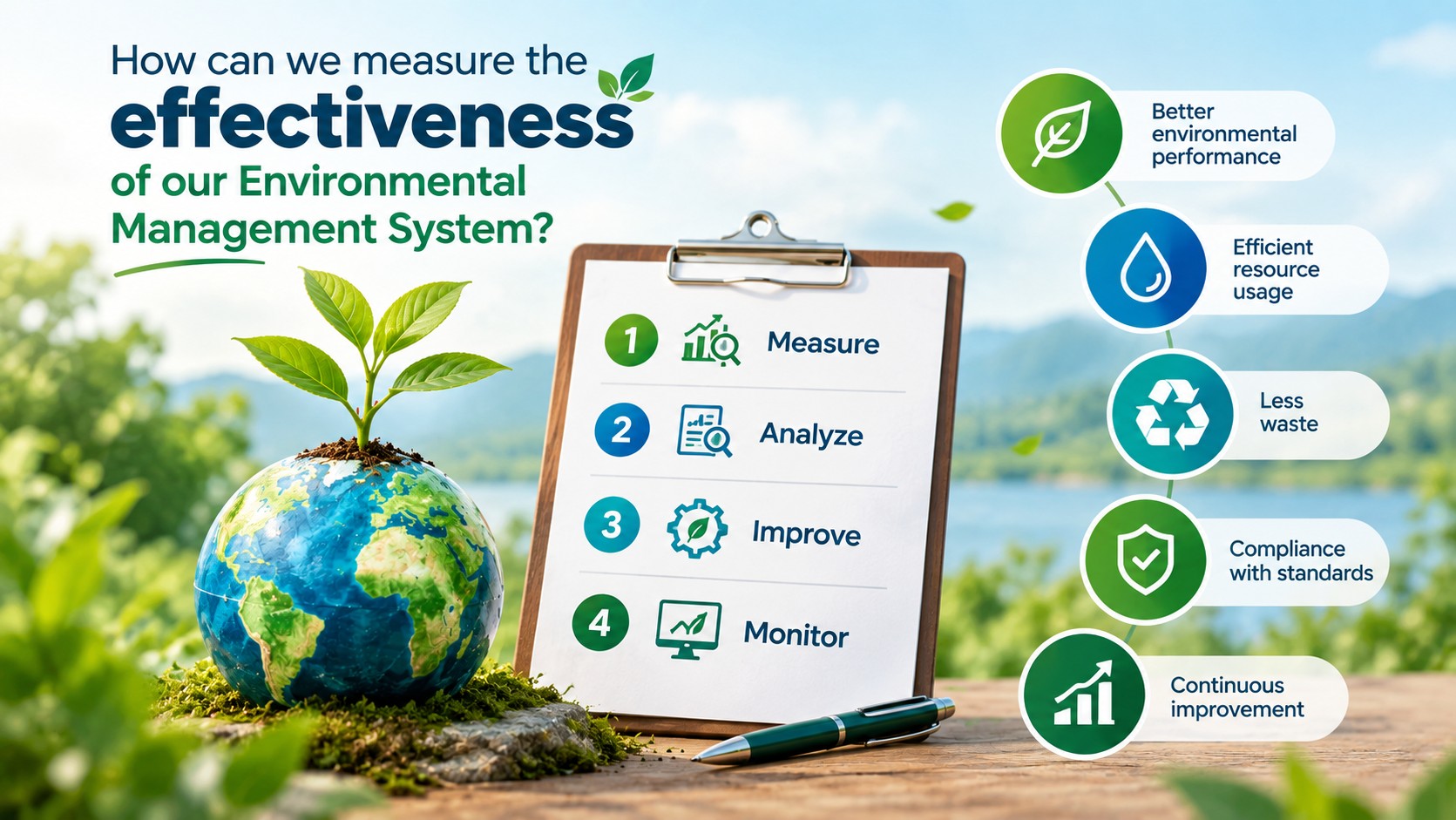
An EMS can look impressive on paper: documented procedures, completed audits, environmental objectives, training records, and pages of performance data.
But when management asks, “Is our EMS actually working?”, having all those records is not enough.
For a Quality Manager, effectiveness needs to be demonstrated with evidence. Are environmental objectives being achieved? Is environmental performance improving? Are compliance obligations being met? Are corrective actions preventing problems from recurring?
This matters because organizations report tangible value from ISO 14001. An ISO 14001 user survey conducted through ISO member bodies, with more than 5,000 responses from 110 countries, found that close to 75% of participants rated the standard highly or very highly for meeting legal requirements and improving environmental performance.
So, how can a Quality Manager determine whether an EMS is delivering these results?
What Should You Measure to Evaluate EMS Effectiveness?
The right measurements depend on your organization’s significant environmental aspects, compliance obligations, and objectives. However, four areas provide a practical starting point.
1. Environmental Performance
Track the environmental factors that matter most to your operations. Depending on your organization, this may include:
- Energy and water consumption
- Waste generation and recycling
- Greenhouse gas emissions
- Air emissions
- Wastewater discharge
- Raw material or resource consumption
- Environmental incidents such as spills or releases
Where possible, measure performance against a meaningful baseline. For example, energy consumption per unit of production can be more useful than total energy consumption when production volumes change.
The objective is not to collect every possible environmental metric. It is to generate reliable information about the environmental aspects that your EMS is intended to control and improve.
2. Progress Toward Environmental Objectives
An EMS should translate environmental commitments into measurable objectives and targets.
For example:
| Objective | Target | KPI |
| Reduce energy consumption | 10% reduction | kWh per unit produced |
| Reduce waste | 15% reduction | kg of waste per unit produced |
| Improve recycling | 20% increase | % of recyclable waste recovered |
This gives Quality Managers something concrete to evaluate: Are we achieving what we planned to achieve?
If targets are consistently missed, the measurement process should help identify why and whether objectives, controls, resources, or corrective actions need to change.
3. Compliance and Environmental Incidents
Environmental performance cannot be separated from compliance.
Monitor relevant permit conditions, regulatory requirements, environmental incidents, nonconformities, and findings from compliance evaluations. Repeated violations, unresolved findings, spills, or failures to meet permit requirements can indicate weaknesses in the EMS even when other KPIs appear positive.
A useful measurement framework should therefore show not only what went wrong, but whether corrective actions were implemented and whether the problem happened again.
4. Audits, Corrective Actions, and Competence
EMS effectiveness is also reflected in how well the management system responds to problems.
Useful indicators include:
- Number and severity of audit findings
- Repeat findings
- Corrective-action closure rates
- Time taken to close actions
- Environmental incidents and recurrence
- Completion of required environmental training
- Employee competence for environmentally significant activities
These indicators help distinguish between a system that simply records problems and one that actually learns from them.
How Should EMS Performance Be Measured?
Collecting data is only useful if you have a consistent way to evaluate it. ISO 14001:2026 defines effectiveness in terms of whether planned activities are realized and planned results are achieved, while environmental performance can be evaluated against environmental policy, objectives, or other criteria using appropriate indicators.
A practical approach is to establish five things for every important measurement:
What will be measured?
Define the KPI or environmental performance indicator clearly.
How will it be measured?
Specify the method, data source, calculation, and responsible person. Consistent measurement methods make results more reliable and comparable.
What will it be compared against?
Use appropriate criteria such as legal requirements, environmental objectives, targets, historical performance, or an established baseline.
When will it be measured and reviewed?
Not every indicator needs to be monitored at the same frequency. Set a schedule based on the importance and nature of the measurement.
What does the result tell you?
A number on a dashboard is not an improvement by itself. Analyze the result to identify trends, deviations, recurring problems, and opportunities for action.
ISO 14001 measurement guidance also emphasizes defining what will be measured, how it will be measured, the criteria for evaluation, when measurements should occur, and when results should be analyzed.
Looking at trends is particularly important. A single month’s improvement may not indicate sustained performance, while a gradual deterioration can reveal a problem before it becomes a significant environmental incident.
How to Build an EMS Measurement Framework
A Quality Manager can turn these principles into a repeatable measurement process:
- Identify significant environmental aspects: Start with the environmental aspects that can have significant impacts and require control or monitoring.
- Set objectives and targets: Define what the organization wants to achieve and make objectives measurable wherever practical.
- Select relevant KPIs: Choose indicators that directly show whether those objectives and controls are working. Avoid collecting data simply because it is available.
- Establish baselines and measurement methods: Document the starting point, calculation method, data source, frequency, and responsibility for each KPI.
- Monitor and analyze performance: Compare actual results against targets, baselines, legal requirements, and previous performance. Look for meaningful trends rather than isolated results.
- Take action and review: Where performance falls short, investigate the cause, implement corrective action, and evaluate whether the action was effective. Use the results to improve the EMS.
In practice, the cycle is:
Identify → Set → Measure → Analyze → Act → Improve
This makes EMS measurement part of the management system rather than a separate reporting exercise.
How Can QMS Software Support EMS Measurement?
For a Quality Manager, the challenge is often not deciding what to measure. It is maintaining the documents, records, responsibilities, actions, and evidence behind those measurements.
QMS Software can support an EMS by bringing these activities into one structured system.
| EMS activity | How QMS Software can help |
| Environmental procedures and records | Document Control Software keeps controlled documents and records organized |
| KPI and performance monitoring | Quality Reports, Charts & Lists help turn quality and environmental data into usable reports. |
| Environmental competency | Training Management Software helps manage training records and requirements. |
| Environmental risks | Risk Management Software supports systematic risk management. |
| Environmental nonconformities | Nonconformance Management Software helps document and track issues. |
| Corrective actions | CAPA Management Software helps assign, track, and close corrective actions. |
| EMS audits | Audit Management Software helps manage audits and findings. |
The software does not make an EMS effective on its own. Its value is in giving Quality Managers a structured way to capture evidence, maintain traceability, monitor performance, follow up on problems, and demonstrate that actions were taken.
Turning EMS Measurement Into Continuous Improvement
Measuring EMS effectiveness is ultimately about more than collecting environmental data.
A strong measurement process tells you whether environmental objectives are being achieved, whether compliance is being maintained, where performance is deteriorating, and whether corrective actions are actually working. It gives Quality Managers the evidence needed to support management review, audits, and decisions about where improvement is needed.
If managing all this information across spreadsheets, documents, emails, and separate records makes it difficult to maintain a clear picture of EMS performance, an integrated system can help connect the information and processes behind it.
QISS QMS brings document control, audits, corrective actions, training, risk management, nonconformities, and reporting together in one platform, helping teams maintain more organized and traceable management-system records.
If you’re looking for a more connected way to manage your quality and environmental processes, request a demo to see how QISS QMS can help your team turn management-system data into actionable insights and continual improvement.