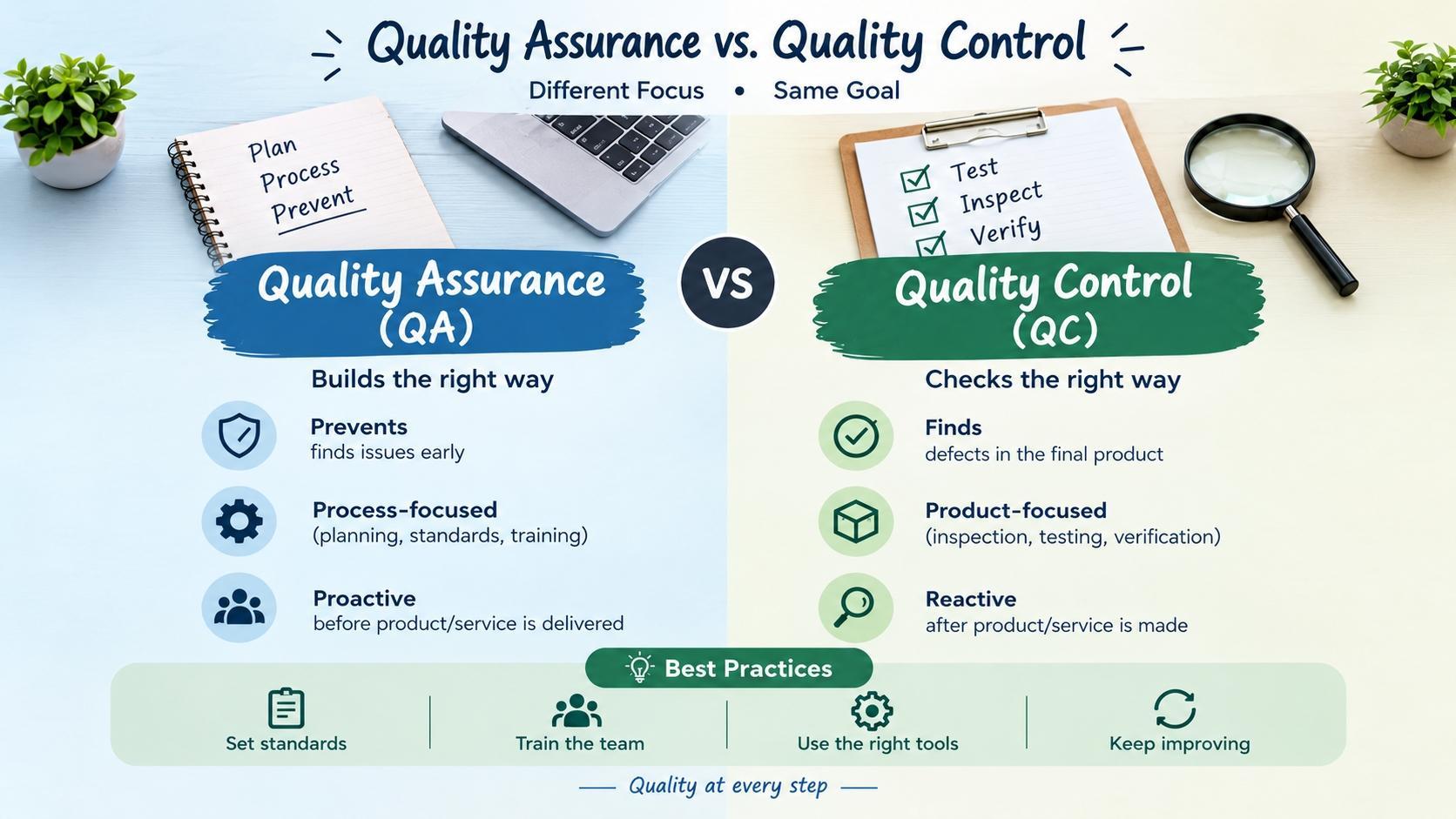
Quality assurance and quality control are often used interchangeably, but they serve different purposes.
Quality assurance (QA) focuses on preventing quality problems by controlling and improving processes.
Quality control (QC) focuses on identifying problems by checking products, services, or results against requirements.
Both are necessary. A strong quality system does not choose between QA and QC. It uses QC findings to strengthen processes and prevent the same problems from recurring.
Quality Assurance vs. Quality Control: What’s the Difference?
| Quality Assurance (QA) | Quality Control (QC) | |
| Primary focus | Processes | Outputs |
| Main goal | Prevent problems | Detect problems |
| Approach | Proactive | Detective |
| Typical timing | Throughout the process | At defined inspection or testing points |
| Common activities | Procedures, training, audits, process improvement | Inspection, testing, measurement |
| Key question | Are we controlling the process properly? | Does the result meet requirements? |
The distinction is simple, but the two functions are closely connected.
QA establishes the conditions needed to produce consistent results. QC provides evidence that those results actually meet the required specifications.
These differences are reflected in ISO’s explanation of quality assurance, which describes QA as process-oriented and preventive, while QC focuses on checking whether outputs meet specified requirements.
What Does Quality Assurance Involve?
Quality assurance is about building quality into the way work is performed rather than waiting for a defect to appear.
Typical QA activities include:
- Establishing and maintaining procedures
- Controlling quality documentation
- Training employees on required processes
- Conducting internal audits
- Monitoring process performance
- Identifying process risks
- Improving processes when weaknesses are found
The emphasis is on consistency and prevention.
A practical example
Imagine a manufacturer repeatedly receives complaints about incorrectly assembled products.
A QA response would not simply tell inspectors to check more products.
Instead, the organization might review the assembly procedure, employee training, work instructions, process controls, and audit findings to determine why the process allows the error to happen.
That is QA thinking: improve the system that creates the problem.
What Does Quality Control Involve?
Quality control focuses on checking whether the output meets established requirements.
Common QC activities include:
- Product or material inspection
- Laboratory testing
- Measurement and sampling
- In-process checks
- Final inspections
- Recording and evaluating test results
- Identifying nonconforming products or results
For example, a QC inspector may discover that a manufactured component is outside its dimensional specification. The immediate responsibility is to identify and record the nonconformance and prevent an unacceptable product from moving forward.
But that should not necessarily be the end of the process.
If the same dimensional problem keeps appearing, the organization needs to investigate the process causing it.
How Do Quality Assurance and Quality Control Work Together?
QA and QC should not operate as two disconnected functions.
A useful way to see their relationship is:
Requirements → QA establishes the process → Work is performed → QC checks the output → Nonconformance identified → Correction/CAPA → Effectiveness checked → Process improved → QA strengthens the process
QC tells you that something went wrong. QA helps determine how to make sure it does not keep going wrong.
For example, a QC team might identify repeated defects in a production batch. The organization can then investigate the root cause, determine corrective action, verify whether the action worked, and update the relevant process or training.
When a QC check identifies a nonconformance, the issue also needs to be recorded, assessed, and resolved rather than simply removed from the production line. A structured nonconformance management process helps organizations track the issue, investigate its cause, and determine appropriate corrective action.
Where Do Common Quality Activities Fit?
Some quality activities clearly sit closer to QA or QC. Others connect both.
| Quality activity | Primary role | Why it matters |
| Document control | QA | Keeps processes and requirements controlled |
| Employee training | QA | Builds consistent process execution |
| Internal audits | QA | Evaluates whether processes are being followed |
| Inspection and testing | QC | Checks whether outputs meet requirements |
| Nonconformance | QC → QA | Detects an issue and provides input for improvement |
| CAPA | Both | Addresses causes and prevents recurrence |
| Continuous improvement | Both | Uses quality information to strengthen the system |
For example, an inspection may identify a failed product, but the resulting nonconformance may reveal that a procedure, training program, supplier control, or process needs attention.
If an issue is significant or recurring, the next step may be CAPA: identifying the root cause, implementing corrective action, and verifying whether it actually worked. This is where the CAPA process moves a quality issue beyond an immediate correction and toward preventing recurrence.
What QA and QC Look Like in Real Situations
Manufacturing
QA: Establishes production procedures, document controls, employee training, and audit processes.
QC: Inspects materials, performs in-process checks, measures finished products, and records nonconformances.
When they connect: Repeated defects identified by QC can trigger corrective action and process improvement within the broader quality system.
Healthcare
QA: Establishes and monitors reliable processes, training requirements, documentation, and quality improvement activities.
QC: Checks specific results, measurements, records, or services against defined requirements.
The distinction matters because checking the final result cannot compensate for a poorly controlled process upstream.
Laboratory
Laboratories provide a particularly clear example of why QA and QC need to work together.
A laboratory may have accurate equipment and effective QC checks, but problems can still occur before a sample reaches the testing stage.
In a PubMed review of laboratory testing, 61.9%–68.2% of errors occurred in the preanalytical phase, including issues involving patient preparation, sample collection, transportation, and handling.
That means checking the analytical result alone is not enough. QA has to address the processes surrounding the test, while QC continues to verify the quality of the analytical work.
Best Practices for Managing QA and QC Together
A few principles make the distinction useful in practice:
- Define requirements clearly
People cannot consistently meet requirements that are unclear, outdated, or difficult to access. - Standardize critical processes
Use controlled procedures and work instructions for activities where inconsistency could affect quality. - Train people on the process
Training should be maintained as procedures, responsibilities, and requirements change. - Use QC data to identify patterns
One failed inspection may be an isolated event. Repeated failures can indicate a systemic process problem. - Investigate significant or recurring nonconformances
Do not stop at correcting the individual defective product. Ask why the problem occurred and whether it could happen again. - Connect corrective action to its source
Audit findings, inspections, complaints, and nonconformances can all provide inputs for corrective action. - Verify that corrective actions worked
Closing an action is not the same as demonstrating that the underlying problem has been addressed.
How Does a QMS Connect QA to QC?
QA and QC are the activities. A quality management system (QMS) provides the framework for managing those activities consistently.
Consider what happens when a QC inspection identifies a recurring defect:
Inspection → Nonconformance → Root Cause → Corrective Action → Effectiveness Check → Process Improvement
If these steps are managed through separate spreadsheets, emails, and folders, it becomes harder to maintain the connection between the original finding and the action taken.
A QMS brings related quality processes together so information can move from one stage to the next.
For organizations looking to move beyond disconnected quality records, a QMS for managing quality processes can provide centralized visibility across documentation, audits, nonconformances, CAPA, training, and other quality activities.
How Can QMS Software Support QA and QC?
QMS software does not replace quality professionals or perform QA and QC by itself. Its value is in making the underlying processes easier to control, track, and connect.
| Quality need | How QMS software can help |
| Document control | Maintain controlled quality documents and records |
| Training | Track training requirements and records |
| Audits | Organize audit activities and findings |
| Nonconformances | Record and track quality issues |
| CAPA | Manage corrective actions and follow-up |
| Quality information | Provide centralized visibility into quality activities |
For example, quality teams can use audit management software to organize audit activities and findings, while QMS workflows can connect significant findings to subsequent corrective actions.
The important point is not simply digitizing individual activities. It is maintaining the connection between them.
QA Prevents. QC Detects. A QMS Connects Them.
Quality assurance and quality control are different, but they are not competing approaches.
QA builds and improves the process. QC checks the result. A connected QMS helps organizations manage both as part of one continuous quality system.
When quality information is connected from documentation and training through inspections, nonconformances, and corrective action, quality teams have a clearer view of what is happening and where improvement is needed.
If your organization is still managing quality activities across disconnected spreadsheets, files, and emails, request a free demo to see how a connected quality system can support your QA and QC processes.
Related Articles
- How Quality Control Software Reduces Defects and Rework Costs in Manufacturing
- Document Control for Quality Assurance in the Manufacturing Industry
- When Should an NCR Be Issued & How to Resolve It?
- Definition, Types & Importance of Non-Conformance
- Difference Between Calibration and Quality Control in a Laboratory