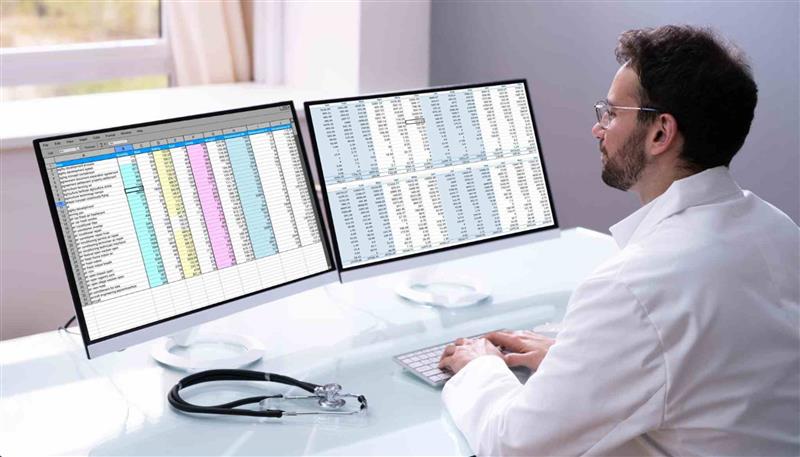
In many laboratories, spreadsheets are often the first tool used to organize operational data. They are accessible, familiar, and flexible enough to handle early-stage tracking of samples, test results, or equipment records. For small teams managing limited volumes of data, spreadsheets can be sufficient. Their low barrier to entry makes them especially attractive – most teams already know how to use them, they require little to no upfront investment, and they can be set up quickly without specialized IT support.
Why Do Spreadsheets Work Well in Early-Stage or for Small Laboratories?
For new, small, or lower-volume laboratories, spreadsheets offer several practical advantages that make them a logical starting point for data management.
First, spreadsheets have an extremely low barrier to entry. Most laboratory staff are already familiar with tools like Excel or Google Sheets, meaning little to no training is required. This allows teams to start organizing data immediately without waiting for system implementation or onboarding.
Second, spreadsheets provide flexible structure. Laboratories can design data tables, tracking logs, and reporting formats that match their specific workflows. As processes evolve, spreadsheets can be quickly modified without needing configuration changes or vendor support.
Third, spreadsheets are low cost. For many labs — particularly startups, research labs, or small testing facilities — avoiding upfront software investment can be important during early growth stages.
Finally, spreadsheets allow for fast setup. Instead of waiting weeks or months for system deployment, labs can begin tracking samples, results, or equipment data within hours.
For laboratories managing relatively low data volumes with simple workflows, spreadsheets can serve as a practical short-term solution for basic data organization.
However, as laboratory operations grow in scale and complexity, the limitations of spreadsheet-based management become increasingly difficult to ignore.
When Spreadsheets Stop Working for the Lab
Spreadsheets rarely fail all at once. Instead, they gradually become harder to manage as more users, datasets, and processes become involved.
Version control is often the first challenge. When multiple users maintain separate copies of files, inconsistencies emerge quickly. Even with shared drives or cloud-based sheets, it is difficult to track who changed data, when it was changed, and why. In regulated laboratory environments, the lack of a reliable audit trail introduces serious compliance risk.
Data fragmentation is another common issue. Laboratories frequently end up maintaining multiple spreadsheets across different departments- one for samples, another for equipment, another for deviations, and another for training records. This fragmentation makes it difficult to gain a complete operational view or identify organization-wide trends.
Manual processes add additional risk. Tasks such as calibration scheduling, maintenance tracking, or deviation logging often rely on manual reminders or individual oversight. As workloads increase or staffing changes occur, these processes become more vulnerable to missed steps, creating downstream quality and compliance risks.
Perhaps most critically, spreadsheets struggle to support true end-to-end traceability. Modern laboratories are increasingly required to demonstrate complete data lineage — from sample receipt through testing, result generation, review, approval, and archival. Attempting to reconstruct this history across disconnected spreadsheets is time-consuming and error-prone.
Typical warning signs that spreadsheets are no longer scaling with the lab include:
- Increased time spent searching for data
- Uncertainty about which dataset is correct
- Difficulty preparing for audits or inspections
- Recurring documentation or process errors
- Growing dependence on specific individuals to maintain systems
When these issues begin to impact productivity, compliance confidence, or data reliability, it is often a signal that the laboratory has outgrown manual tracking tools.
The Hidden Cost of “Free” Spreadsheet Management
While spreadsheets appear cost-effective on the surface, their true cost often becomes visible over time.
Time is one of the largest hidden expenses. Highly skilled laboratory personnel can spend significant time manually entering data, cross-checking records, reconciling versions, or preparing audit documentation. This reduces time available for core scientific or analytical work.
Compliance risk is another major hidden cost. Missing audit trails, incomplete traceability, or inconsistent data control can lead to audit observations, corrective actions, or even regulatory penalties. The financial and reputational impact of compliance gaps often far exceeds the cost of implementing a structured system.
Operational inefficiency also accumulates. Duplicate data entry, manual reporting, and fragmented data sources slow decision-making and reduce organizational agility. As labs grow, maintaining spreadsheet-based systems often requires more administrative effort without improving data quality or process control.
Over time, what appears “free” can become significantly more expensive than a structured digital solution.
A Realistic Perspective on Spreadsheet Use in Laboratories
Spreadsheets can be highly practical for small teams or early-stage laboratories, offering flexibility, low cost, and quick setup. They are well-suited for simple workflows and limited data volumes, allowing teams to organize and track information efficiently in the early stages.
Over time, however, as operations expand, processes become more interconnected, and data volumes grow, spreadsheets can gradually become harder to manage. Version inconsistencies, fragmented records, and reliance on manual tracking can slowly affect efficiency, traceability, and confidence in results.
By periodically assessing how data is organized and monitored, laboratories can better understand the strengths and limitations of spreadsheets, ensuring they continue to serve as a useful tool while maintaining reliable and consistent operations.
To learn more about best practices for laboratory data management, visit our lab management resources.