
Root Cause Analysis Software
Uncover the underlying causes of quality issues, nonconformities, customer complaints, and process failures with root cause analysis software. Structure investigations, collaborate with responsible teams, document findings, and connect root causes to corrective and preventive actions—all within a centralized quality management system.
Replace spreadsheets, scattered records, and inconsistent investigations with a systematic approach to problem-solving that supports continuous improvement and stronger quality outcomes.



Our Clients













What Is Root Cause Analysis Software?
Root cause analysis software helps organizations investigate problems, identify why they occurred, and determine what needs to change to prevent them from happening again.
Instead of addressing only the immediate symptoms of a problem, root cause analysis tools guide teams through a structured investigation process. They help collect evidence, apply problem-solving methodologies, document contributing factors, assign investigation responsibilities, and track actions resulting from the findings.
Whether you’re investigating a product defect, a recurring nonconformity, a failed audit, or a customer complaint, root cause analysis software gives your team a consistent, traceable way to understand problems and drive improvement.
Simplify Root Cause Investigations
Structured Root Cause Investigations
Standardize how your team investigates quality problems with a consistent, documented workflow. Capture the problem statement, investigation details, supporting evidence, contributing factors, and conclusions in one place.
Give investigators a clear process to follow so that investigations are thorough, repeatable, and easier to review.
5 Why Method for Root Cause Analysis
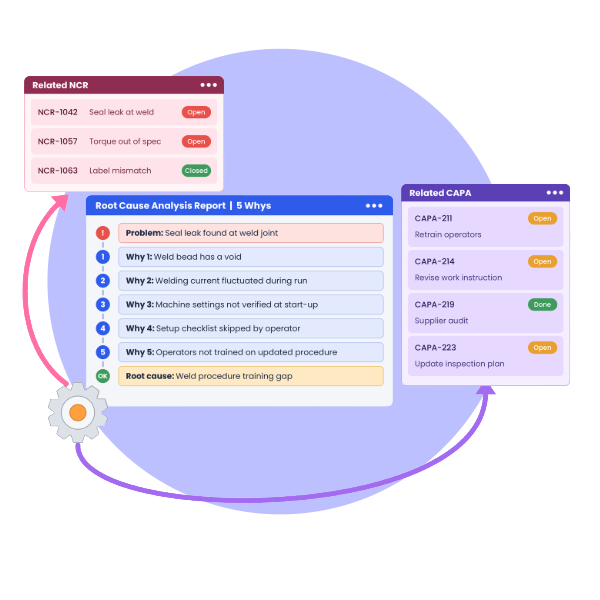
Identify the underlying cause of quality issues with the 5 Why method. This problem-solving technique helps your team move beyond surface-level symptoms by repeatedly asking “Why?” until the underlying cause of a problem becomes clear.
Evidence and Investigation Records
Support root cause conclusions with documented evidence rather than assumptions. Maintain investigation notes, relevant records, supporting documents, and findings alongside the associated quality issue. Keep investigation information organized and accessible to authorized personnel for reviews, approvals, audits, and future reference.
Corrective and Preventive Action Tracking
Turn investigation findings into meaningful improvements. Link identified root causes to corrective actions that address existing problems and preventive actions that reduce the likelihood of similar issues occurring elsewhere. Assign responsibilities, establish due dates, monitor progress, and maintain traceability from the original problem through action completion.
Root Cause Analysis for Nonconformities
Investigate nonconformities originating from inspections, internal audits, supplier issues, production processes, or customer feedback. Connect the investigation to the relevant nonconformance record, document the cause, and use the findings to guide appropriate corrective action.
Customer Complaint Investigations
Understand why customers experience product defects, service failures, or recurring quality problems. Bring complaint details, investigation findings, and resulting actions into a connected workflow. Use recurring complaint trends to identify opportunities for process improvement and customer satisfaction.

How Does Root Cause Analysis Software Work?
Follow a structured process from problem identification to verified resolution.
Step 1: Identify and Define the Problem
Record the issue, describe its impact, identify the affected product or process, and establish the scope of the investigation.
Step 2: Collect Relevant Evidence
Gather records, inspection results, audit findings, process information, and other evidence needed to understand what happened.
Step 3: Analyze Potential Causes
Use methods such as 5 Whys, Fishbone diagrams, or other suitable techniques to investigate contributing factors and determine the underlying cause.
Step 4: Document the Root Cause
Record the investigation findings and explain how the identified cause contributed to the problem. Ensure conclusions are supported by appropriate evidence.
Step 5: Assign Corrective and Preventive Actions
Determine the actions needed to address the cause, assign owners, set target dates, and connect actions to the relevant quality record.
Step 6: Verify Effectiveness
Evaluate whether the actions have addressed the identified cause and reduced the likelihood of recurrence. Document the effectiveness review and initiate further action if the problem persists.
The result:
A consistent, traceable investigation process that helps your organization move from reactive problem-solving to systematic quality improvement.
Why Use Root Cause Analysis Software Instead of Spreadsheets?
Manual investigations can become difficult to manage as the number of quality issues, departments, and corrective actions increases.
| Manual investigations | Root cause analysis software |
|---|---|
| Investigation details scattered across files and emails | Centralized investigation records |
| Inconsistent analysis methods | Standardized investigation workflows |
| Limited visibility into action ownership | Assigned responsibilities and due dates |
| Difficult traceability between issues and actions | Connected quality records and actions |
| Time-consuming manual reporting | More accessible investigation data and reports |
| Effectiveness checks easily overlooked | Documented follow-up and effectiveness reviews |
| Recurring problems difficult to analyze | Better visibility into repeated causes and trends |
Move beyond documenting problems. Build a repeatable process for understanding why they occur and preventing them from happening again.
Support ISO 9001 and Other Quality Management Requirements
A structured root cause investigation process can support quality management activities associated with standards and regulatory frameworks, including:
- ISO 9001: Nonconformity evaluation, cause analysis, corrective action, and effectiveness review.
- ISO 13485: Investigation of nonconformities and corrective or preventive action activities relevant to medical device quality management.
- IATF 16949: Structured problem-solving and corrective action processes in automotive quality management.
- FDA Quality Management System Regulation (QMSR): Investigation and corrective-action processes applicable to medical device manufacturers within the regulation’s scope.
- ISO 14001 and ISO 45001: Investigation of environmental nonconformities, incidents, and related corrective actions where applicable.
Root cause analysis software can help organize records, standardize workflows, and improve traceability. Software alone does not establish compliance; organizations must implement appropriate procedures and meet the requirements applicable to their operations.

Connect Root Cause Analysis With Your Quality Management System
Root cause analysis is most effective when it is part of a broader quality management process rather than an isolated activity.
Integrating investigations with related QMS processes helps teams maintain context, reduce duplicate data entry, and follow problems through to resolution.
- Nonconformance Management: Initiate investigations from identified nonconformities and link findings to the original record.
- CAPA Management: Convert verified root causes into corrective and preventive actions and track their completion.
- Audit Management: Investigate audit findings, document causes, and monitor resulting actions.
- Customer Complaint Management: Connect customer feedback to investigations and quality improvements.
- Supplier Quality Management: Investigate supplier-related defects and recurring delivery or material issues.
- Risk Management: Use investigation findings to reassess relevant risks and determine whether additional controls are needed.
- Document Control: Review and update affected procedures, work instructions, or controlled documents when an investigation identifies a documentation or process gap.
A connected QMS helps maintain traceability from the initial problem through investigation, action, and effectiveness verification.
Frequently Asked Questions
The purpose is to help organizations identify the underlying causes of problems, document investigation findings, coordinate corrective actions, and verify whether those actions prevent recurrence.
Common methods include 5 Whys, Fishbone diagrams, Pareto analysis, cause-and-effect analysis, and FMEA. The most appropriate method depends on the problem, available evidence, and level of risk.
Yes. It can help organize nonconformity investigations, document causes, connect findings to corrective actions, and maintain records for review. Organizations must still follow their documented processes and meet applicable ISO 9001 requirements.
It can help reduce recurrence by supporting evidence-based investigations, appropriate corrective actions, and effectiveness reviews. Results depend on the quality of the investigation, the suitability of the actions, and how effectively they are implemented.
It helps teams investigate problems consistently, connect findings to corrective actions, identify recurring trends, and use documented evidence to support continual improvement.
Find the Root Cause. Make Lasting Improvements.
Stop relying on fragmented investigation records and corrective actions that address only the symptoms. Give your team a structured way to investigate quality issues, document findings, assign actions, and verify effectiveness. With integrated root cause analysis and quality management workflows, your organization can improve investigation consistency, strengthen accountability, and make better-informed decisions.